

𝗞𝘂𝘄𝗲𝗻𝘁𝗼𝗻𝗴 𝗣𝗲𝘆𝘂𝗽𝘀 𝗔𝘁𝗯𝗽. 𝗯𝘆 𝗔𝘁𝘁𝘆. 𝗗𝗲𝗻𝗻𝗶𝘀 𝗚𝗼𝗿𝗲𝗰𝗵𝗼
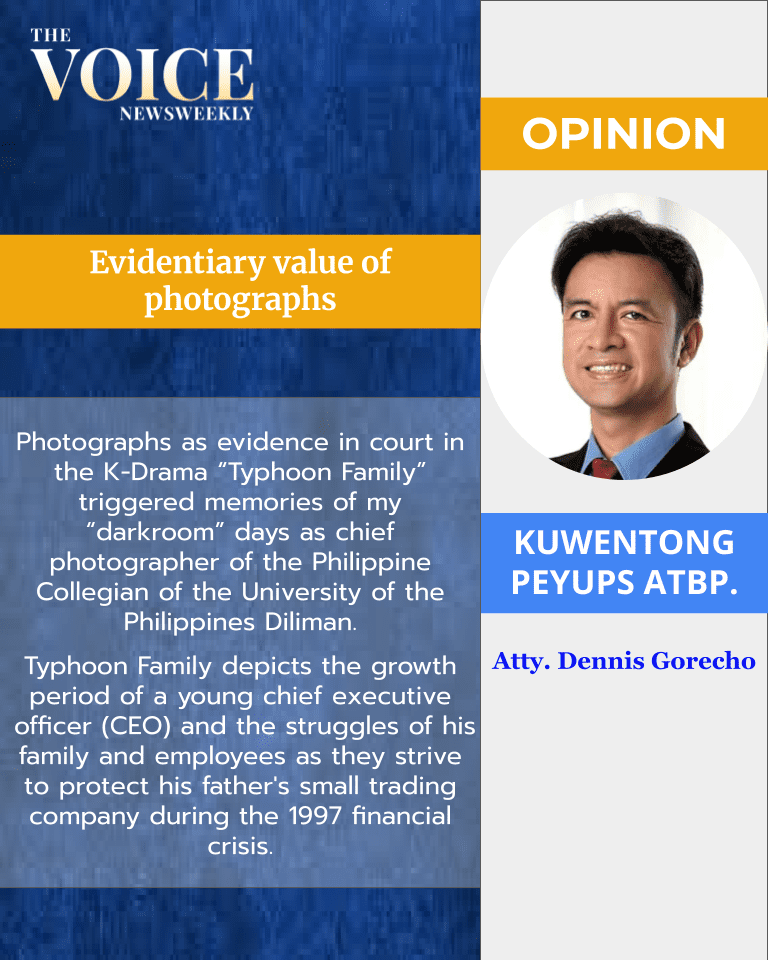
Photographs as evidence in court in the K-Drama “Typhoon Family” triggered memories of my “darkroom” days as chief photographer of the Philippine Collegian of the University of the Philippines Diliman.
Typhoon Family depicts the growth period of a young chief executive officer (CEO) and the struggles of his family and employees as they strive to protect his father’s small trading company during the 1997 financial crisis.
In Episodes 8, 9, and 10, the main characters, Kang Tae-poong (Lee Jun-ho) and Oh Mi-seon (Kim Min-ha) travelled to Thailand for a business trip for export of motorcycle helmets. Mi-seon unknowingly took photos that later became crucial evidence to exonerate Go Ma-jin, who was arrested by Thai police on suspicion of bribery.
Mi-seon remembered Kang’s advice that “records are clearer than memory” and realized she had the incident on film. The pair raced against time to find a photo studio in Thailand to develop the photos overnight before a crucial trial in Korea. Unfortunately, the printed photos were not used as these were accidentally thrown to the river.
However, Kang used the negatives to show the images via a makeshift projector.
I felt a close relation with the photographer as he worked inside the darkroom.
As the Philippine Collegian’s chief photographer from 1989 to 1991, the darkroom was my happy place at a time when you capture events like rallies on film and not digitally, then see the images come to life inside the darkroom.
Darkroom photography is the traditional, hands-on process of developing film and printing photos in a light-proof room. It involves using chemical processes and equipment like an enlarger to turn negatives into physical prints on light-sensitive paper. The process relies on a completely dark room, except for a safe light (typically red or amber), to handle and expose photosensitive paper without ruining it.
In legal proceedings, photographs can serve as powerful forms of evidence. These visual aids can corroborate testimonies, clarify facts, and provide judges and juries with a clearer understanding of the events in question.
In these cases, the courts assess the relevance, authenticity, and probative value of the photographs in determining their admissibility and weight.
Photographic evidence (including digital photos, videos) is admissible if it’s relevant, competent, and authenticated as an accurate representation of the subject, often requiring testimony from the photographer or someone with personal knowledge to confirm its exactness and freedom from alteration, with photocopies/duplicates allowed if the original’s authenticity is not genuinely questioned. This is in accordance with the Philippine Rules on Evidence and Rules on Electronic Evidence.
In Guerrero vs. Phil. Phoenix Surety (G.R. No. 223178, December 09, 2020), the Supreme Court said that a competent witness must be able to “assure the court that they know or are familiar with the scenes or objects shown in the pictures and the photographs depict them correctly.
In Cadajas vs People (G.R. No. 247348, November 16, 2021), the Court affirmed the conviction of Cadajas for violation of R.A. No. 9775, the Anti-Child Pornography Act using social media posts.
The SC ruled that a person cannot invoke his constitutional right to privacy if the photographs and messages from his social media posts are pieces of evidence obtained by private individuals and not by law enforcers or by other government agents.
The Court said: “While the constitutional provision highlights the importance of the right to privacy and its consequent effect on the rules on admissibility of evidence, one must not lose sight of the fact that the Bill of Rights was intended to protect private individuals against government intrusions. Hence, its provisions are not applicable between and amongst private individuals.”
The SC noted that violation of the right to privacy between individuals is properly governed by the provisions of the Civil Code, the Data Privacy Act (DPA) and other pertinent laws, while its admissibility shall be governed by the rules on relevance, materiality, authentication of documents, and the exclusionary rules under the Rules on Evidence,”
In Serrano v. Cruz-Angeles, the SC ruled that screenshots qualify as admissible documentary evidence under Section 2, Rule 130 of the Rules of Court. This rule encompasses “writings, recordings, photographs or any material containing letters, words, sounds, numbers… or other modes of written expression offered as proof of their contents.” Screenshots, being stored images of online content, meet this threshold.
One of the major challenges due to technology advancement is that digital photographs can become altered more easily than film-based images and that supposed original images recorded on a camera’s light-sensitive chip can be manipulated.
(𝑃𝑒𝑦𝑢𝑝𝑠 𝑖𝑠 𝑡ℎ𝑒 𝑚𝑜𝑛𝑖𝑘𝑒𝑟 𝑜𝑓 𝑡ℎ𝑒 𝑈𝑛𝑖𝑣𝑒𝑟𝑠𝑖𝑡𝑦 𝑜𝑓 𝑡ℎ𝑒 𝑃ℎ𝑖𝑙𝑖𝑝𝑝𝑖𝑛𝑒𝑠. 𝐴𝑡𝑡𝑦. 𝐷𝑒𝑛𝑛𝑖𝑠 𝑅. 𝐺𝑜𝑟𝑒𝑐ℎ𝑜 ℎ𝑒𝑎𝑑𝑠 𝑡ℎ𝑒 𝑆𝑒𝑎𝑓𝑎𝑟𝑒𝑟𝑠’ 𝐷𝑖𝑣𝑖𝑠𝑖𝑜𝑛 𝑜𝑓 𝑡ℎ𝑒 𝑆𝑎𝑝𝑎𝑙𝑜 𝑉𝑒𝑙𝑒𝑧 𝐵𝑢𝑛𝑑𝑎𝑛𝑔 𝐵𝑢𝑙𝑖𝑙𝑎𝑛 𝐿𝑎𝑤 𝑂𝑓𝑓𝑖𝑐𝑒𝑠. 𝐹𝑜𝑟 𝑐𝑜𝑚𝑚𝑒𝑛𝑡𝑠, 𝑒-𝑚𝑎𝑖𝑙 𝑖𝑛𝑓𝑜@𝑠𝑎𝑝𝑎𝑙𝑜𝑣𝑒𝑙𝑒𝑧.𝑐𝑜𝑚, 𝑜𝑟 𝑐𝑎𝑙𝑙 0908866578)