


𝗞𝘂𝘄𝗲𝗻𝘁𝗼𝗻𝗴 𝗣𝗲𝘆𝘂𝗽𝘀 𝗔𝘁𝗯𝗽. 𝗯𝘆 𝗔𝘁𝘁𝘆. 𝗗𝗲𝗻𝗻𝗶𝘀 𝗚𝗼𝗿𝗲𝗰𝗵𝗼
“Mabining Mandirigma: A Steampunk Musical” by Tanghalang Pilipino pays homage to women in celebration of Women’s Month through the portrayal of Apolinario Mabini by a female actor.
The title role of Mabini is notably played by a female lead. This non-traditional casting choice has been a signature of the production, with several acclaimed actresses taking on the role across various runs.
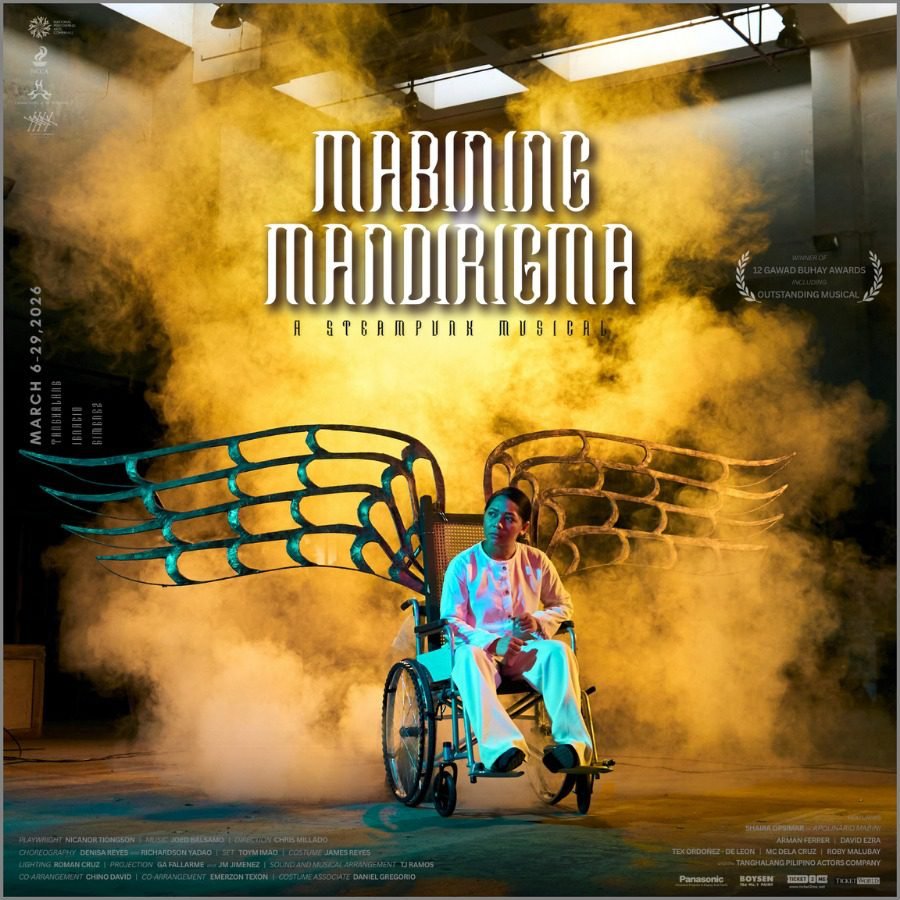
Shaira Opsimar (2026) is the latest stage actress to portray Mabini, which include Delphine Buencamino in 2015, Liesl Batucan in 2016, Hazel Grace Maranan in 2016 and Monique Wilson in 2019.
Maranan is a descendant of Mabini as her grandfather, the late Pablo Maranan, traces his roots to Mabini’s mother, Dionisia Maranan.
I was able to watch two female Mabinis, Wilson in 2019 and now Opsimar.
The musical was written by Nicanor Tiongson, with music by Joed Balsamo and direction by Chris Millado.
Mabining Mandirigma is a steampunk musical that follows the life of Apolinario Mabini (1864-1903), who, through his intellect and principles, called on Filipinos to rise above class, region, and self-interest in order to build a nation.
The musical begins in 1898 with Mabini already serving as adviser to Emilio Aguinaldo (played by Arman Ferrer and David Ezra) and Cabinet president, and traces his conflict-ridden career marked by opposition to compromisers like Felipe Buencamino and Pedro Paterno, his fall from grace and break with the naïve Aguinaldo, exile to Guam and return to the country with principles intact. Mabini died of cholera just three months after he came back to his native land, at 38.
He was legal and constitutional adviser to the Revolutionary Government in 1898 and the first Prime Minister of the Philippines upon the establishment of the First Philippine Republic in 1899.
Two of his works, El Verdadero Decálogo (1898) and Programa Constitucional de la República Filipina (1898), became instrumental in the drafting of the Malolos Constitution.
Mabini performed all his revolutionary and governmental activities despite having lost the use of both his legs to polio shortly before the Philippine Revolution of 1896.
Casting a woman as Mabini highlights his intellectual prowess over physical strength, as what Mabini lacked in physical prowess, he made up for in bravado and passion.
Opsimar expressed that portraying Mabini, a male historical figure, acts as a message of empowerment for women to stand up and not be belittled.
Performing the role carries a message of empowerment, Opsimar said in an interview adding “that a fire will be ignited in their hearts—and that they will act on it. Stand up. Don’t be afraid to stand up.”
Fernando Jose, TP’s artistic director said that they opted for a woman to be the lead player due to technical, vocal and musical reasons.
“MabinI’s voice should be entirely different from the predominantly “male” voices of Mabini’s antagonists. Philosophically, Mabini is an “othered” human being, being physically challenged, coming from a poor family, and assigning the role to a female actor somehow implies that the woman in the human society is traditionally, an othered being, “babae lang”, Josef said.
Josef added that the physically challenged, wheelchair bound character played by a woman actor “is the strongest, bravest, most principled, most respectable, admirable heroic person of integrity in the story.”
Mabining Mandirigma is part of TP’s tribute to three revolutionary heroes through a trilogy of musicals: “Pingkian” for Emilio Jacinto, “Gregoria Lakambini” for Gregoria de Jesus, and “Mabining Mandirigma” for Mabini.
In “Pingkian: Isang Musikal”, Jose Rizal was portrayed by a woman, Kakki Teodoro.
All of the performers of “Gregoria Lakambini” are female, including those who portrayed Bonifacio and Nakpil.
Toym Imao, current dean of the University of the Philippines College of Fine Arts, is the person behind the stage design since the musical was first shown in 2015.
“The scenic design of this year’s MM pays homage to the original set design done in 2015. All the elements relate to contemporary teams, like industrialization, to today’s disruptive technologies and how old systems of authoritarianism, imperialism, corruption, compromise, and shifting allegiances are represented in the visual metaphors of the productions set pieces,” Imao said.
Imao added the humanist elements to serve as the bookend of the musical. It starts with ” the duyan/ hammock as the womb that birthed Mabini and his journey through life, which in the finale transforms into a catafalque that brings him to his grave.”
Originally staged in 2015 and recognized with 12 Gawad Buhay Awards, the musical returns for its 10th anniversary with shows that will run at the Cultural Center of the Philippines (CCP) Tanghalang Ignacio Jimenez until March 29, 2026.
(𝑃𝑒𝑦𝑢𝑝𝑠 𝑖𝑠 𝑡ℎ𝑒 𝑚𝑜𝑛𝑖𝑘𝑒𝑟 𝑜𝑓 𝑡ℎ𝑒 𝑈𝑛𝑖𝑣𝑒𝑟𝑠𝑖𝑡𝑦 𝑜𝑓 𝑡ℎ𝑒 𝑃ℎ𝑖𝑙𝑖𝑝𝑝𝑖𝑛𝑒𝑠. 𝐴𝑡𝑡𝑦. 𝐷𝑒𝑛𝑛𝑖𝑠 𝑅. 𝐺𝑜𝑟𝑒𝑐ℎ𝑜 ℎ𝑒𝑎𝑑𝑠 𝑡ℎ𝑒 𝑆𝑒𝑎𝑓𝑎𝑟𝑒𝑟𝑠’ 𝐷𝑖𝑣𝑖𝑠𝑖𝑜𝑛 𝑜𝑓 𝑡ℎ𝑒 𝑆𝑎𝑝𝑎𝑙𝑜 𝑉𝑒𝑙𝑒𝑧 𝐵𝑢𝑛𝑑𝑎𝑛𝑔 𝐵𝑢𝑙𝑖𝑙𝑎𝑛 𝐿𝑎𝑤 𝑂𝑓𝑓𝑖𝑐𝑒𝑠. 𝐹𝑜𝑟 𝑐𝑜𝑚𝑚𝑒𝑛𝑡𝑠, 𝑒-𝑚𝑎𝑖𝑙 𝑖𝑛𝑓𝑜@𝑠𝑎𝑝𝑎𝑙𝑜𝑣𝑒𝑙𝑒𝑧.𝑐𝑜𝑚, 𝑜𝑟 𝑐𝑎𝑙𝑙 0908-8665786.)