Res Ipsa Loquitur
By Atty. Dennis Gorecho
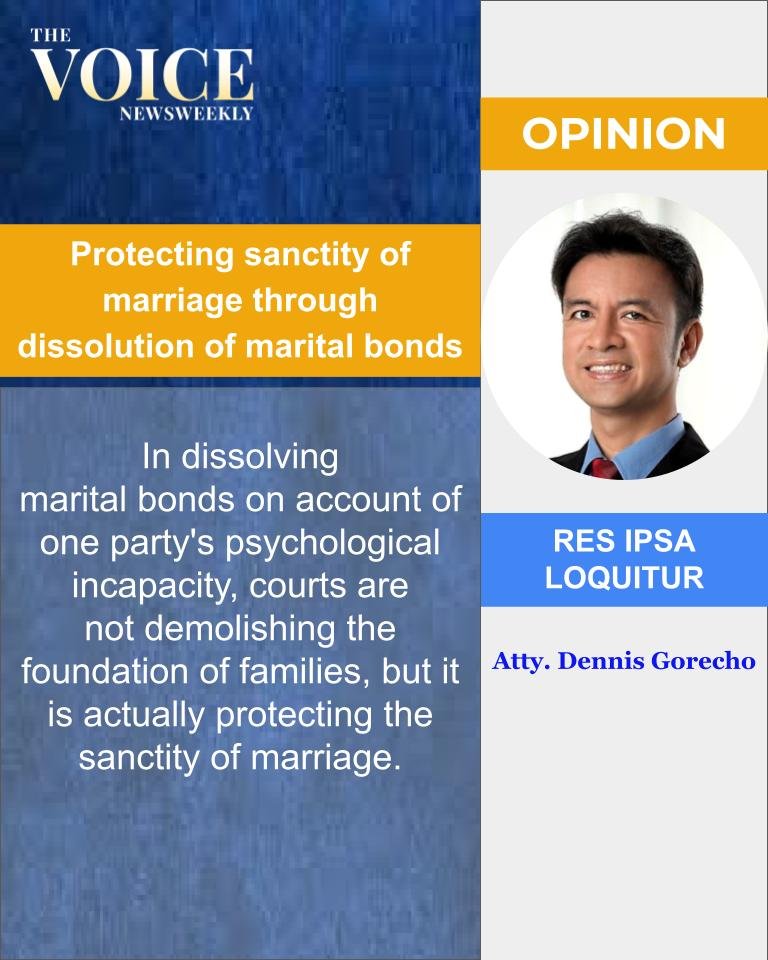
In dissolving marital bonds on account of one party’s psychological incapacity, courts are not demolishing the foundation of families, but it is actually protecting the sanctity of marriage.
This was emphasized by the Supreme Court in the case of De Silva vs. De Silva (G.R. No. 247985, October 13, 2021) as it refuses to allow a person afflicted with a psychological disorder, who cannot comply with or assume the essential marital obligations, from remaining in that sacred bond.
Article 36 of the Family Code holds that “a marriage contracted by any party who, at the time of the celebration, was psychologically incapacitated to comply with the essential marital obligations of marriage, shall likewise be void even if such incapacity becomes manifest only after its solemnization.”
The Court stressed that marriage is not just a civil contract, but a new relation, an institution the maintenance of which the public is deeply interested.
Given the particular nature of marriage characterized as a lifetime commitment which cannot be dissolved by simple whim of the parties, the State has surrounded it with safeguards to preserve its purity, continuity, and permanence, especially since the security and stability of the State is largely dependent on it.
The Court noted that the fulfillment of the obligations of marriage depends on the strength of this interpersonal relationship.
A serious incapacity for interpersonal sharing and support is held to impair the relationship and consequently, the ability to fulfill the essential marital obligations.
The marital capacity of one spouse is not considered in isolation but in reference to the fundamental relationship to the other spouse.
Psychological incapacity refers to a personal condition that prevents a spouse to comply with fundamental marital obligations only in relation to a specific partner that may exist at the time of the marriage but may have revealed through behavior subsequent to the ceremonies.
The totality of the evidence must show clear and convincing proof to cause the declaration of nullity of marriage.