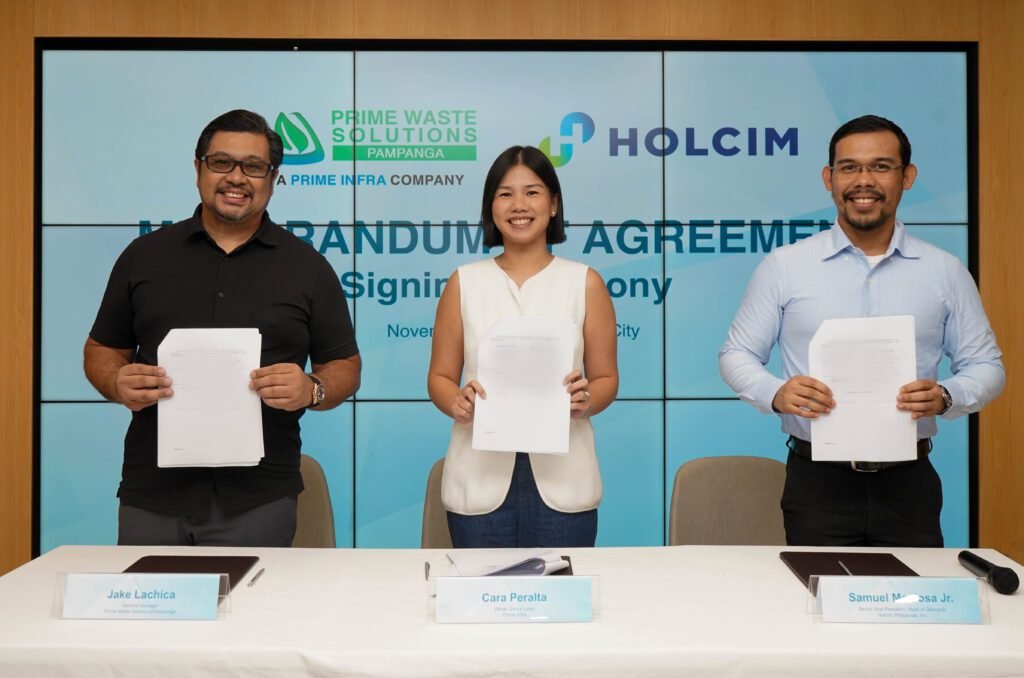
Prime Infra-led Prime Waste Solutions (PWS) Pampanga, Inc. has formalized a partnership with Holcim Philippines, Inc., one of the country’s leading sustainable construction companies, for the supply of refuse-derived fuel (RDF) to Holcim’s cement plants in Bulacan and La Union.
Under the Memorandum of Agreement (MOA), PWS Pampanga will deliver a steady supply of RDF produced from processed plastic waste to support Holcim’s cement manufacturing operations. Through co-processing technology, the waste will be transformed into alternative fuel and raw materials—reducing Holcim’s dependence on traditional fossil fuels and promoting circular economy practices.
The agreement was signed by Cara Peralta, Prime Infra Market Sector Lead for Waste; Jake Lachica, PWS Pampanga General Manager; and Samuel Manlosa Jr., Holcim Senior Vice President and Head of Geocycle.
“It is rare to find like-minded organizations such as Holcim willing to partner with us and make investments in sustainable practices like RDF consumption,” said Peralta. “We are excited to start this partnership, especially at a time when effective waste management and environmentally sustainable business practices are urgently needed.”
Manlosa echoed this, emphasizing Holcim’s alignment with Prime Infra’s sustainability goals.
“We know we’re working with a company that values what we do—leadership in waste management and a strong commitment to growth with quality and efficiency,” he said.
Inaugurated in June 2024, PWS Pampanga’s state-of-the-art waste management facility in Porac can process up to 5,000 tons per day. It utilizes advanced systems such as vibrating sieves, baler systems, and magnetic separators to ensure efficient waste segregation, maximize resource recovery, and minimize landfill dependency.
PWS’ Cebu facility also processes shredded plastics into RDF for industrial partners, supporting the company’s goal of building a sustainable waste management ecosystem across the Philippines.
Meanwhile, Holcim, through its waste management unit Geocycle, has long employed co-processing technology to divert community waste from landfills and use it as alternative fuel in its cement kilns—helping reduce the industry’s carbon footprint while promoting a circular economy.