



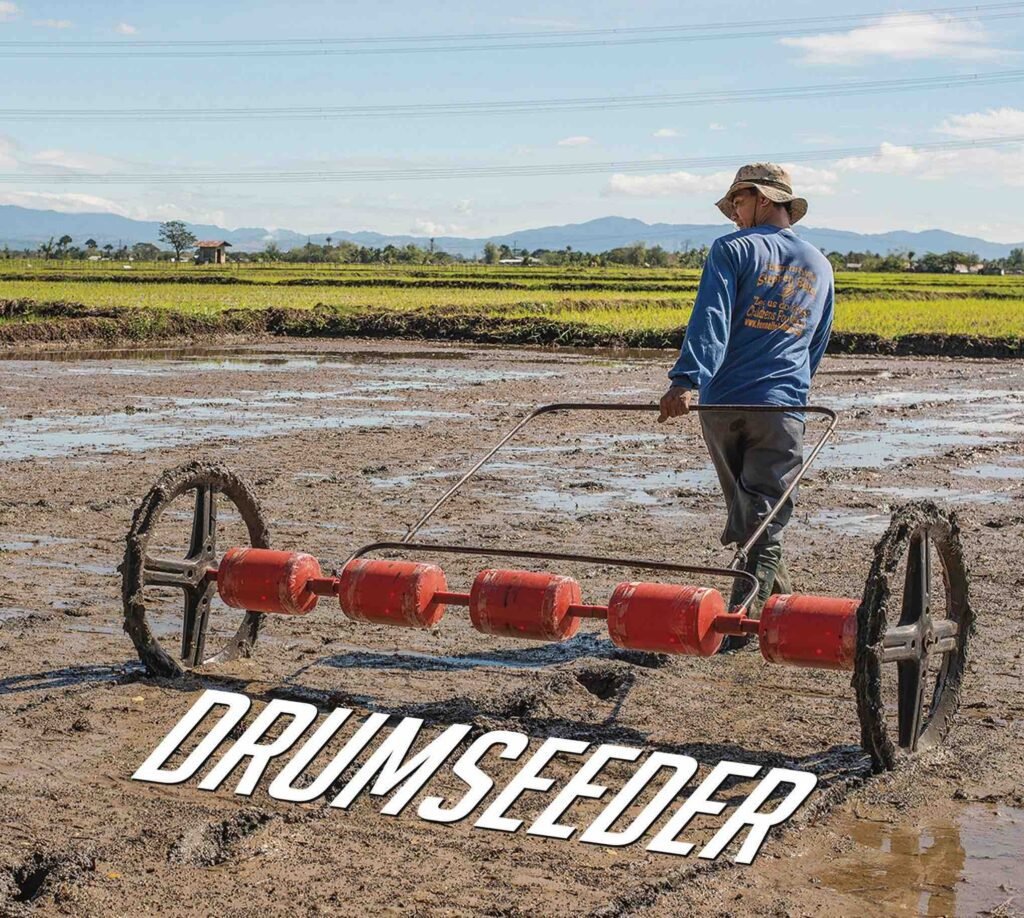
The Philippine Rice Research Institute (PhilRice) is encouraging rice farmers to adopt drum seeder technology to achieve faster, more efficient, and cost-effective rice planting.
PhilRice Science Research Specialist Tyrone Juganas said the drum seeder is a direct seeding device that evenly distributes rice seeds in straight rows on prepared fields, improving planting efficiency compared to traditional methods.
“The drum seeder produces well-aligned rows that make field management easier, unlike manual broadcasting where the lack of defined rows often results in uneven crop growth,” Juganas explained.
He noted that the technology helps reduce seed usage, lowering production costs and minimizing the need for additional farm inputs. Proper row alignment also makes weed and pest management easier and allows farmers to use mechanical weeders, further cutting labor expenses.
Juganas advised farmers to prepare their fields properly before using the drum seeder, emphasizing the importance of clean and level land with well-maintained dikes to ensure smooth operation and effective weed control.
“Farmers should complete Palay Key Check Two by ensuring clean, level fields, well-maintained dikes, and properly decomposed weeds before direct seeding,” he said.
He added that the recommended seeding rate is 30 to 40 kilograms per hectare for inbred varieties and 20 to 25 kilograms per hectare for hybrid rice.
According to Juganas, drum seeder technology also reduces overall production costs by eliminating the need for seedbed preparation and transplanting, while preventing planting shock that can negatively affect crop growth.
PhilRice continues to urge farmers and farmer groups to coordinate with the institute for training and technical guidance on drum seeder use as part of its ongoing efforts to promote mechanized and sustainable rice farming.