
𝗞𝘂𝘄𝗲𝗻𝘁𝗼𝗻𝗴 𝗣𝗲𝘆𝘂𝗽𝘀 𝗔𝘁𝗯𝗽. 𝗯𝘆 𝗔𝘁𝘁𝘆. 𝗗𝗲𝗻𝗻𝗶𝘀 𝗚𝗼𝗿𝗲𝗰𝗵𝗼
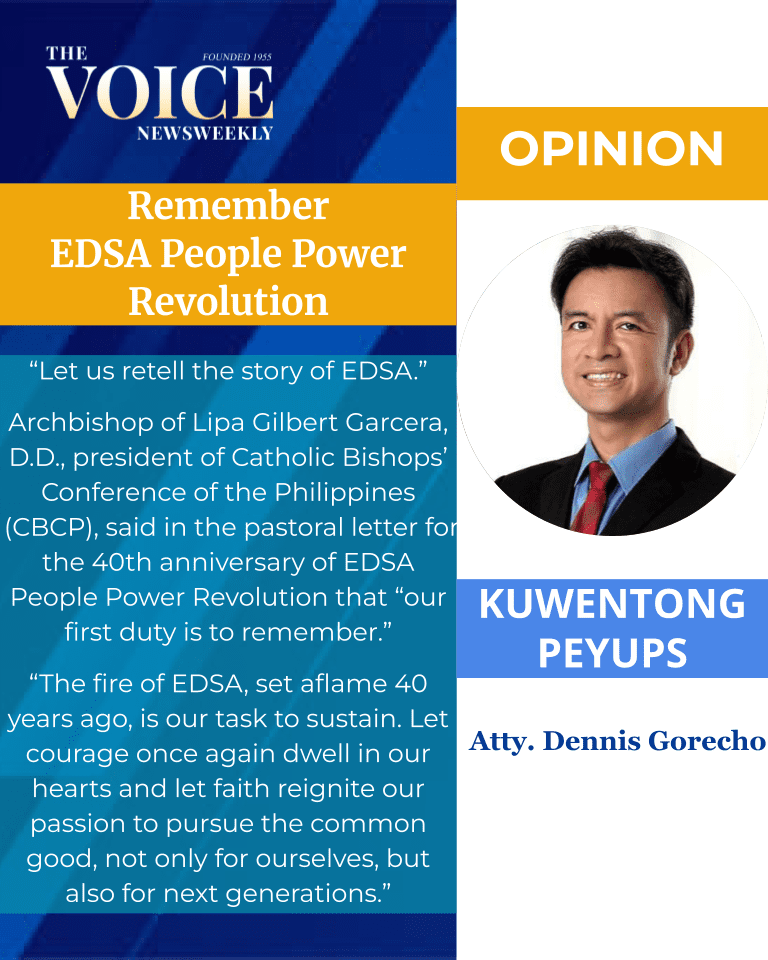
“Let us retell the story of EDSA.”
Archbishop of Lipa Gilbert Garcera, D.D., president of Catholic Bishops’ Conference of the Philippines (CBCP), said in the pastoral letter for the 40th anniversary of EDSA People Power Revolution that “our first duty is to remember.”
“The fire of EDSA, set aflame 40 years ago, is our task to sustain. Let courage once again dwell in our hearts and let faith reignite our passion to pursue the common good, not only for ourselves, but also for next generations.”
Garcera added that the “the dictatorship fell, not through violence but through quiet perseverance and power of piety and collective faith that clamored for justice and true change.”
Bishop Garcera lamented that Filipinos “have squandered the gift of EDSA xxx as we forgot that freedom is both a task and a duty.”
I was 15 years old and about to finish high school when I accompanied my relatives to participate in EDSA. I admit that I did not have a full grasp of the reason why millions of Filipinos converged along EDSA in Metro Manila, and in cities all over the country.
Ferdinand Marcos Sr. was the longest-serving president in Philippine history, holding office for over 20 years, from December 30, 1965, until he was ousted on February 25, 1986. His 21-year rule (7,362 days) included a period of martial law from 1972 to 1981, allowing him to stay in power beyond his initial terms.
Instead of its promised stability and prosperity, the imposition of Martial Law generated intense social conflicts and a worsening economic crisis.
Growing civil discontent and political opposition combined with a restive military to resist the repressive Marcos regime.
The Marcos dictatorship is historically remembered for its record of human rights abuses, particularly targeting political opponents, student activists, journalists, religious workers, farmers, and others who fought against his dictatorship.
The four-day EDSA People Power Revolution was a culmination of a series of public protests against the oppressive and abusive dictatorial government and alleged electoral fraud committed by Marcos, Sr. It led to the forced exile of the Marcos family and their close allies to Hawaii, where he died in 1989.
“It was a moral victory for the Filipino people; a realization of and obedience to the people’s Will.” former Chief Justice Marcelo Fernan said in Marcos vs Manglapus (G.R. No. 88211 September 15, 1989).
The Supreme Court cases that declared some of the Marcos assets to be “ill-gotten” include $658 million in Republic v. Sandiganbayan, (G.R. No. 152154. July 15, 2003); PLDT shares in Yuchengco v. Sandiganbayan (GR NO. 149802, Jan 20, 2006); US$3.37 million in Marcos Jr. v. Republic (G.R. No. 189434 April 25, 2012) and collection of jewelry (Estate of Marcos v. Republic (G.R. No. 213027January 18, 2017).
Human rights violations during the Marcos regime were recognized through the passage of Republic Act (R.A.) No. 10368 in 2013 that aims to provide reparations to victims by using the allocated PHP10 billion from Marcos’s ill-gotten wealth.
The current Constitution embodied a long list of “directive principles” and welfare state clauses, along with a strong Bill of Rights, detailed guarantees against a Marcos-style power-grab, and restored the checks-and balances among three separate branches of government.
Forty years after the 1986 People Power Revolution, seven presidents were elected into office: Corazon Aquino (1986–1992); Fidel Ramos (1992–1998); Joseph Estrada (1998–2001); Gloria Macapagal-Arroyo (2001–2010); Benigno Aquino III (2010–2016); Rodrigo Duterte (2016–2022); and Ferdinand “Bongbong” Marcos Jr. (2022–present).
Three were children of former presidents: Arroyo, Aquino III and Marcos Jr.
Two presidents were female: Cory Aquino and Arroyo.
Estrada was not able to finish his term and was replaced by Arroyo as he was deposed by the EDSA 2 event in 2001.
Duterte is the first Philippine president to face an international tribunal, the International Criminal Court (ICC) due to his controversial war on drugs.
The Marcos family was allowed back into the Philippines in the 1990s, which led to rebuilding their political base in Ilocos Norte before returning to national prominence.
The election of Marcos, Jr. in 2022 highlighted a generational shift, where younger voters, not having lived through the martial law era, were more susceptible to, or influenced by, pro-Marcos narratives.
The systematic digital campaign on platforms like TikTok and Facebook recast the elder Marcos’s martial law era as a “golden age” of prosperity and infrastructure, while downplaying documented human rights abuses and corruption.
It is a reflection of what former Supreme Court Chief Justice Claudio Teehankee declared in the case of Olaguer vs Military Commission (G.R. No. L-54558 May 22, 1987) “the greatest threat to freedom is the shortness of human memory.”
Neverforget the spirit of EDSA!
(Peyups is the moniker of the University of the Philippines. Atty. Dennis R. Gorecho heads the Seafarers’ Division of the Sapalo Velez Bundang Bulilan Law Offices. For comments, e-mail info@sapalovelez.com, or call 0908-8665786.)