
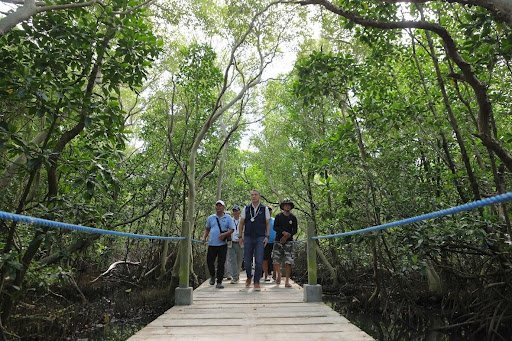


Once vulnerable to high tides, storm surges, and declining fish catches, coastal communities in Balanga City are now benefiting from restored mangrove forests that serve as natural barriers against flooding while helping revive local fisheries.
The transformation of the Balanga Wetland and Nature Park highlights how nature-based solutions can strengthen climate resilience while protecting livelihoods and biodiversity.
Jaime Buenaventura, chair of the City Fishery and Aquatic Resources Management Council (CFARMC), recalled how widespread mangrove cutting left communities exposed to rising waters and declining fish catches.
Today, thriving mangrove forests help slow floodwaters, weaken strong waves, and provide breeding and nursery grounds for fish and other marine species.
During an inspection of the wetland park, Environment Secretary Juan Miguel “Mitch” T. Cuna, accompanied by DENR regional officials, Mayor Raquel Garcia, and community representatives, underscored the importance of protecting natural ecosystems as part of the country’s climate adaptation and flood mitigation efforts.
The Department of Environment and Natural Resources (DENR) has supported the initiative through technical assistance, capacity-building, ecosystem monitoring, and the deployment of River Rangers. Trash traps and waste interception systems have also been installed to prevent pollution from reaching mangrove and estuarine areas.
Community participation has been central to the project’s success, with local fishermen and volunteers helping plant and nurture mangroves along the coastline.
Fisherman Benjie Manuel said the restored mangroves have helped protect homes and fishponds from strong waves during recent typhoons while improving fishery yields. He reported that fishermen’s incomes have more than doubled as marine resources recovered.
The benefits also extend to local businesses. Seafood processor Armanda Battad noted that healthier mangrove ecosystems help ensure a steady supply of seafood while attracting visitors and creating opportunities for tourism.
Despite the progress, River Rangers continue to conduct cleanups and maintain waste interception facilities to protect waterways and sustain the wetlands.
For Manuel, the mangroves represent both livelihood security and community protection.
“We are grateful that we were able to plant mangroves, which have become a defense not only for our fishponds but also for our communities,” he said.
Balanga City’s experience demonstrates how restoring nature can complement conventional flood-control infrastructure, proving that healthy ecosystems can serve as powerful defenses against climate-related hazards while sustaining communities that depend on them.