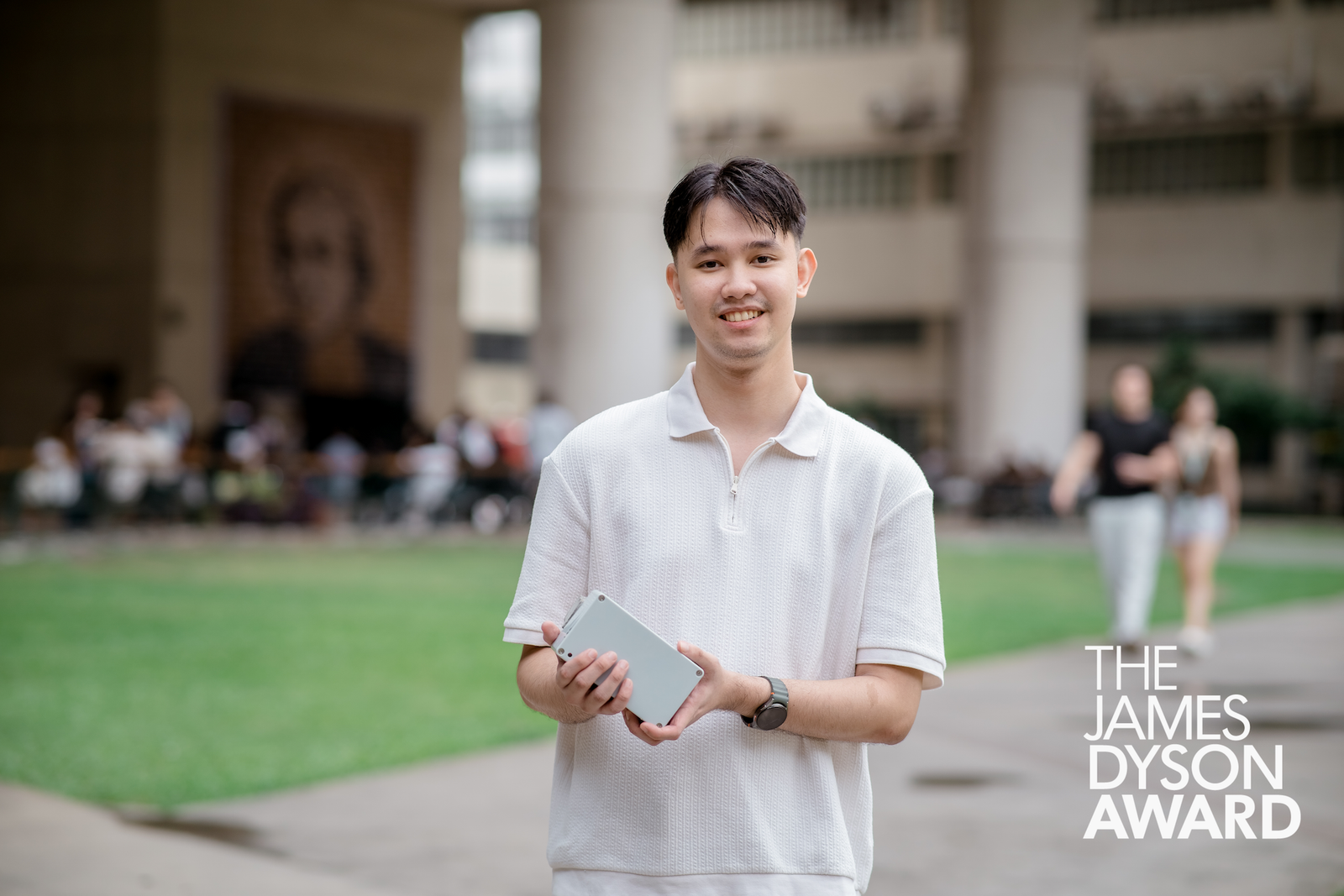
A Filipino engineer is putting local innovation on the global map after winning the 2026 James Dyson Award Global Sustainability Award for developing an affordable sensor that detects hidden structural damage in buildings following earthquakes.
Aldrei Ong, a De La Salle University graduate, earned the international recognition for Sentinel, an innovative building damage monitoring system designed to help prevent structural failures and potentially save lives. He will receive PHP 2.39 million to further develop the technology.
Designed for earthquake-prone countries like the Philippines, Sentinel transforms an ordinary concrete spacer block used in construction into a sensor capable of detecting cracks and internal damage that may not be visible during routine inspections.
The technology uses self-sensing concrete containing conductive materials. When the concrete cracks or sustains damage, its electrical resistance changes. Embedded electrodes and an electronic module monitor these changes and wirelessly transmit data to an online dashboard, allowing engineers to assess a building’s condition remotely.
Unlike conventional structural inspections, which can be time-consuming and costly after major earthquakes, Sentinel offers a potentially faster and more affordable way to identify buildings that may require further assessment.
Ong developed the innovation through his master’s research, testing more than 125 concrete samples over a year to refine the material and its damage-detection capabilities. Sentinel sensors have since been installed in a Philippine building for real-world monitoring.
James Dyson, founder of Dyson, praised the invention for turning an existing construction component into an affordable early-warning system that could help prevent people from occupying structurally unsafe buildings.
Ong said the award recognizes years of persistence, experimentation and learning from failure, while strengthening his determination to make buildings safer.
He plans to further validate Sentinel, improve its electronics and develop versions that can also be installed in existing structures.
His achievement brings the James Dyson Award’s Global Sustainability honor back to the Philippines six years after Filipino inventor Carvey Ehren Maigue won in 2020 for AuREUS, a renewable energy innovation using upcycled crop waste.
Now on its 21st year, the James Dyson Award received a record 2,294 entries from 28 countries and regions in 2026, highlighting the growing role of young innovators in developing solutions to pressing global challenges.