𝗞𝘂𝘄𝗲𝗻𝘁𝗼𝗻𝗴 𝗣𝗲𝘆𝘂𝗽𝘀 𝗯𝘆 𝗔𝘁𝘁𝘆. 𝗗𝗲𝗻𝗻𝗶𝘀 𝗚𝗼𝗿𝗲𝗰𝗵𝗼
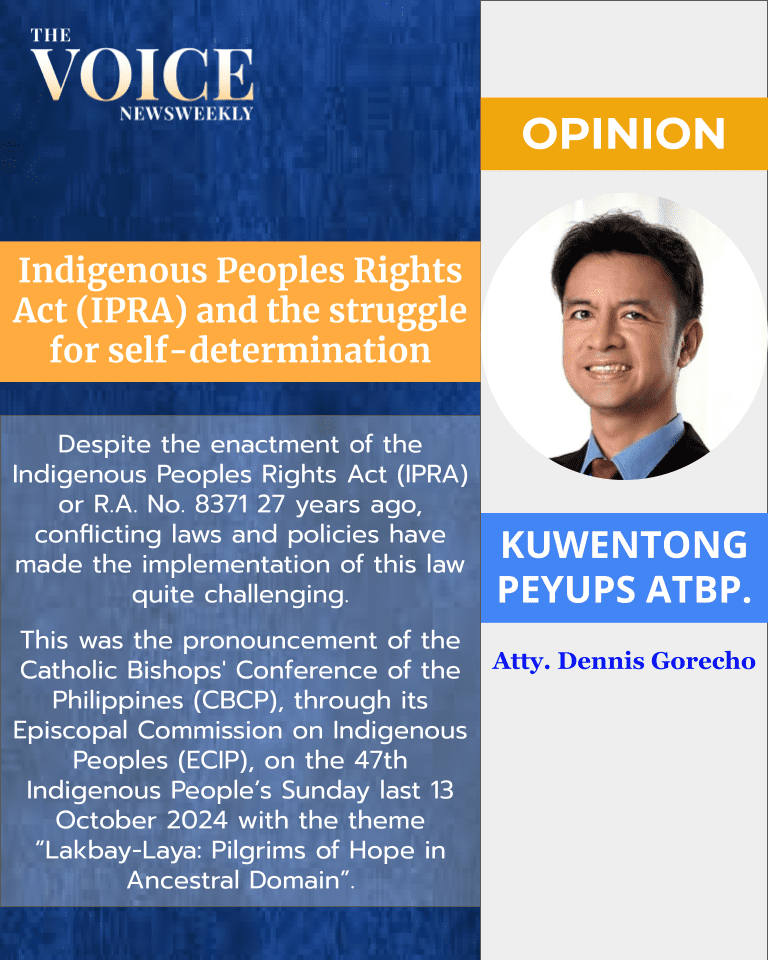
Despite the enactment of the Indigenous Peoples Rights Act (IPRA) or R.A. No. 8371 27 years ago, conflicting laws and policies have made the implementation of this law quite challenging.
This was the pronouncement of the Catholic Bishops’ Conference of the Philippines (CBCP), through its Episcopal Commission on Indigenous Peoples (ECIP), on the 47th Indigenous People’s Sunday last 13 October 2024 with the theme “Lakbay-Laya: Pilgrims of Hope in Ancestral Domain”.
“The celebration of IP Sunday aims to highlight the current situations of indigenous peoples, garner support from our non-indigenous brothers and sisters, and provide the necessary assistance to alleviate the challenges faced by approximately 15 million indigenous people throughout the country,” says Ifugao and Mountain Province Bishop Valentin C. Dimoc, D.D., ECIP chairperson in his letter of appeal.
Bishop Dimoc stressed that “it is crucial to place greater emphasis on our indigenous sisters and brothers, who have long been excluded from many decisions”.
In their July 1978 assembly, the CBCP designated every second Sunday of October as IP Sunday wherein priests are expected to give homilies and commentaries on the plight of the IPs as well as encourage Christian lowlanders to express their solidarity with the IPs’ struggle for self-determination.
The IPRA was signed into law by President Fidel Ramos on October 29, 1997 to support the cultural integrity of IPs, the right to their lands, and the right to self-directed development of these lands.
Former Senator Juan Flavier, one of IPRA’s authors, noted that the “IPs are the offsprings and heirs of the peoples who have first inhabited and cared for the land long before any central government was established”.
The Legal Rights and Natural Resources Center (LRC) said in a paper that much of the legal controversy emanates from overlapping and unclarified jurisdiction of various departments of the government, particularly in the processing and awarding of tenurial instruments.
Despite the aspirations of IPRA, the LRC noted that it may not be interpreted to mean limiting the jurisdiction of Courts nor does it imply that the National Commission on Indigenous People (NCIP) has primary and sole jurisdiction over all Indigenous Cultural Communities (ICCs)/IPs claims and disputes to the exclusion of the regular courts. This also applies to the few criminal cases.
The Supreme Court issued on August 15, 2023 a Writ of Kalikasan against Ipilan Nickel Corp, and Celestial Nickel Mining and Exploration Corp. and in favor of the ICCs of Brooke’s Point, Palawan.
It found that the continued mining operations and excavation of nickel may cause irreparable environmental damage to the Mt. Mantalingahan protected area and the ICCs’ ancestral domain as exhibited by extreme flooding and contamination of fishing areas.
“The indigenous peoples’ struggle for their rights has long been enduring. Their struggle for the recognition of their rights to land and self-determination is rooted in their effort for cultural and human survival. We should honor the struggle of our people,” according to my UP Law professor and now Supreme Court Associate Justice Marvic Leonon in the case of Sama vs People (G.R. No. 224469, January 5, 2021).
Leonen underscored that IPRA recognizes that IPs have a claim of ownership, not only upon the ancestral domain but also on the resources found in them. It acknowledges that the ancestral domain and the resources located therein constitute the IPs’ basis for their cultural integrity.
Justice Leonen stressed in Ha Datu Tawahig vs. Lapinid (G.R. No. 221139, March 20, 2019) that the IPRA was adopted precisely recognizing that indigenous peoples have been “resistant to political, social, and cultural inroads of colonization, non-indigenous religions and cultures, and became historically differentiated from the majority of Filipinos”.
In Daco vs Cabajar, (G.R. No. 222611, November 15, 2021), Justice Leonen said that IPRA grants the ICCs the ownership and possession of their ancestral domains and ancestral lands, and defines the extent of these lands and domains. The ownership given is the indigenous concept of ownership under customary law which traces its origin to native title.
“Tumandok” is the biggest winner for this year’s Cinemalaya Independent Film Festival that centered on the struggle of the Ati indigenous people to reclaim their ancestral domain in Iloilo.
It won Best Film “for its focus on a marginalized sector of Philippine society; for its nearly epic sweep of the life and landscape of a people disempowered by the wealthy and the powerful and victimized by government neglect and corruption; for its highly convincing characters and effective ensemble acting by a cast of non-professional actors; and for its highly effective filmmaking in defense of the rights of indigenous people to their ancestral domain”.
(𝑃𝑒𝑦𝑢𝑝𝑠 𝑖𝑠 𝑡ℎ𝑒 𝑚𝑜𝑛𝑖𝑘𝑒𝑟 𝑜𝑓 𝑡ℎ𝑒 𝑈𝑛𝑖𝑣𝑒𝑟𝑠𝑖𝑡𝑦 𝑜𝑓 𝑡ℎ𝑒 𝑃ℎ𝑖𝑙𝑖𝑝𝑝𝑖𝑛𝑒𝑠. 𝐴𝑡𝑡𝑦. 𝐷𝑒𝑛𝑛𝑖𝑠 𝑅. 𝐺𝑜𝑟𝑒𝑐ℎ𝑜 ℎ𝑒𝑎𝑑𝑠 𝑡ℎ𝑒 𝑆𝑒𝑎𝑓𝑎𝑟𝑒𝑟𝑠’ 𝐷𝑖𝑣𝑖𝑠𝑖𝑜𝑛 𝑜𝑓 𝑡ℎ𝑒 𝑆𝑎𝑝𝑎𝑙𝑜 𝑉𝑒𝑙𝑒𝑧 𝐵𝑢𝑛𝑑𝑎𝑛𝑔 𝐵𝑢𝑙𝑖𝑙𝑎𝑛 𝐿𝑎𝑤 𝑂𝑓𝑓𝑖𝑐𝑒𝑠. 𝐹𝑜𝑟 𝑐𝑜𝑚𝑚𝑒𝑛𝑡𝑠, 𝑒-𝑚𝑎𝑖𝑙 𝑖𝑛𝑓𝑜@𝑠𝑎𝑝𝑎𝑙𝑜𝑣𝑒𝑙𝑒𝑧.𝑐𝑜𝑚, 𝑜𝑟 𝑐𝑎𝑙𝑙 09175025808 or 09088665786.)