

The Global Beat by Gerald Lacuarta
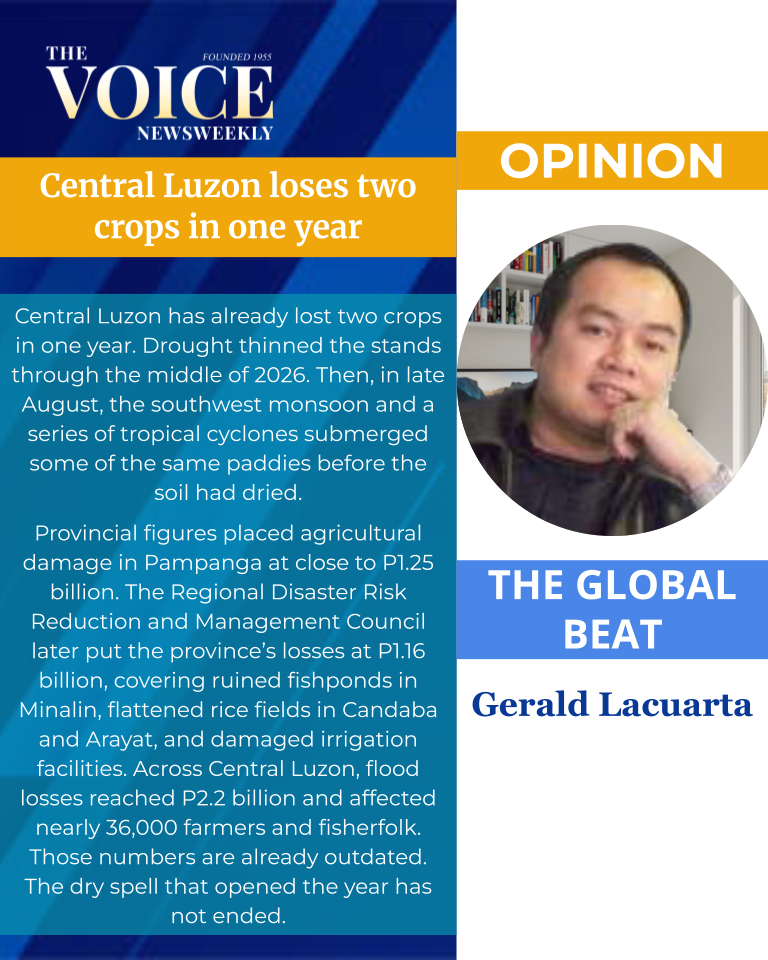
Central Luzon has already lost two crops in one year. Drought thinned the stands through the middle of 2026. Then, in late August, the southwest monsoon and a series of tropical cyclones submerged some of the same paddies before the soil had dried.
Provincial figures placed agricultural damage in Pampanga at close to P1.25 billion. The Regional Disaster Risk Reduction and Management Council later put the province’s losses at P1.16 billion, covering ruined fishponds in Minalin, flattened rice fields in Candaba and Arayat, and damaged irrigation facilities. Across Central Luzon, flood losses reached P2.2 billion and affected nearly 36,000 farmers and fisherfolk. Those numbers are already outdated. The dry spell that opened the year has not ended.
On September 26, the Department of Agriculture released its first El Niño bulletin and placed national agricultural losses at P6.87 billion across 249,000 hectares. Central Luzon is among the regions covered. Corn absorbed the heaviest damage nationwide. Rice losses stood at P1.53 billion. The department said about 77 percent of the affected area can still recover if farm inputs arrive in time. The remaining 23 percent is lost for this cropping cycle. PAGASA expects the El Niño to last through the first half of 2027, so the P6.87 billion tally is a starting figure, not a final one.
Official farmgate prices do not match what farmers in flooded barangays actually received. The average price of palay in Central Luzon rose 32 percent year on year in August, to P20.86 a kilo. A farmer whose crop stood under four feet of water for five days does not get that rate. He sells soaked, discolored grain to traders at a distress price so he can clear the field and pay the day’s labor. Wet palay is poor palay, and buyers pay accordingly. The DA itself has said farmers in areas hit by the habagat did not benefit from the higher prices because excess moisture pulled down grain quality.
Crop insurance is being presented as the main safety net, but the payouts do not match the damage. The Philippine Crop Insurance Corporation recently released about P21 million to 1,435 beneficiaries in the region. The payment helps those who received it. Against P2.2 billion in flood damage, it covers only a small part of the loss. To be paid, a farmer must be registered, hold an active policy before the storm, file within the claims period, and wait for inspection and release. The credit that actually finances small farms — fertilizer taken on account from the local supplier, land preparation arranged by word — does not stop for paperwork. The supplier still expects payment at harvest. If the crop is gone, the debt remains, and the next bag of fertilizer is harder to get.
The drought uses up what little cash a tenant farmer has left. The flood then wipes out the harvest he would have used to secure the next loan. Emergency credit is available: the zero-interest SURE loans, and the Agricultural Credit Policy Council’s newer AGRI-RECOVER releases in Pampanga. Adding another loan, even at zero interest, on top of an unpaid one only postpones the default.
From Nueva Ecija and Tarlac down to the basins of Pampanga and Bulacan, the region cannot keep absorbing two climate shocks in a single year and still serve as the country’s rice bowl.
The response has followed the usual list: seed distribution, mobile pumps, cloud-seeding, and low-interest relief loans. These help after the damage is done. Certified seed that arrives after the planting window has closed is only stock in a warehouse.
The work now is at the barangay and the municipal hall. Short-duration seeds have to reach farmers while the soil can still take them. Secondary canals have to be desilted now, not after the next storm. Insurance money, and assistance tied to the Registry System for Basic Sectors in Agriculture, has to reach the tenant who tills the land, not stop with the landowner whose name is on the title.
Central Luzon does not need another speech on the resilience of the Filipino farmer. In this case, resilience is the word used when drainage, insurance, and relief arrive too late. What the region needs is a cropping season that is not wiped out twice before the grain reaches the mill. If canals are not repaired and aid is not released on time, the palay will spoil in the field again.
Agriculture Secretary Francisco Tiu Laurel Jr., PCIC president Jovy Bernabe, the National Irrigation Administration, and Governor Lilia Pineda should say when the seed, the insurance checks, and the canal work will actually reach Candaba, Arayat, and Minalin.