

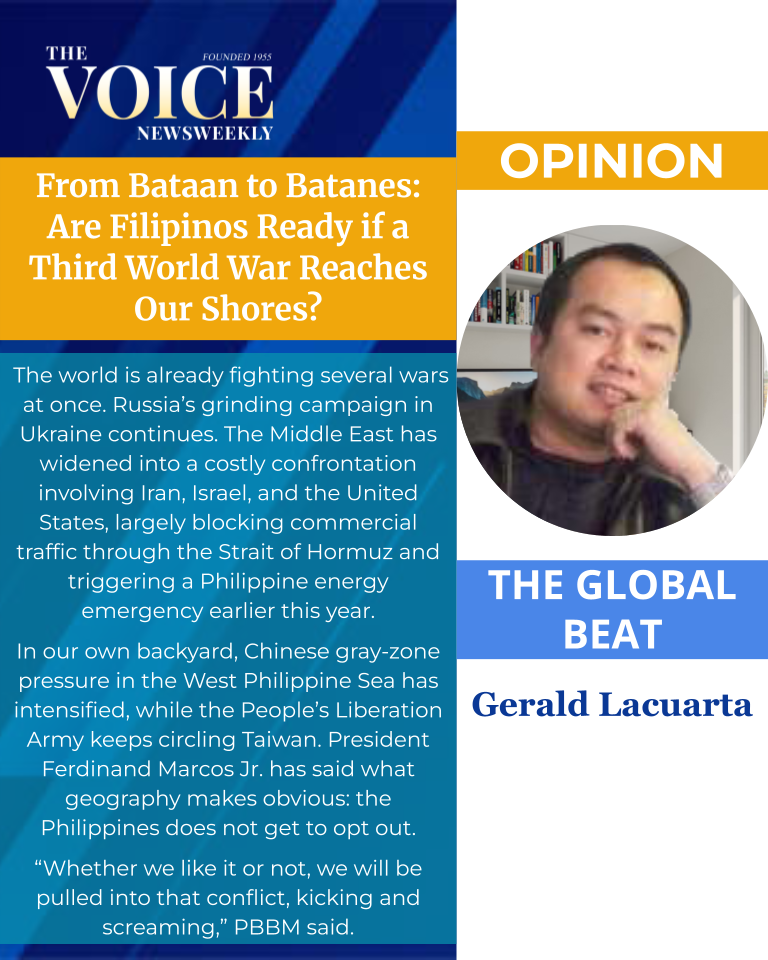
The Global Beat by Gerald Lacuarta
The world is already fighting several wars at once. Russia’s grinding campaign in Ukraine continues. The Middle East has widened into a costly confrontation involving Iran, Israel, and the United States, largely blocking commercial traffic through the Strait of Hormuz and triggering a Philippine energy emergency earlier this year.
In our own backyard, Chinese gray-zone pressure in the West Philippine Sea has intensified, while the People’s Liberation Army keeps circling Taiwan. President Ferdinand Marcos Jr. has said what geography makes obvious: the Philippines does not get to opt out.
“Whether we like it or not, we will be pulled into that conflict, kicking and screaming,” PBBM said.
I heard a version of that warning long before Marcos said it. I grew up in the Cold War shadow of Clark Air Base, when the roar of American jets was part of the afternoon soundtrack in Angeles City and Mabalacat, Pampanga and the perimeter fence felt like the edge of another country.
On clear days you could see the flight line. On tense days you could feel the adults tighten while we children were amazed by the sounds of American jets and choppers flying by. We were told the bases kept us safe. We were also told they made us a target. Both things could be true at once.
Concern about a wider world war is growing, and to totally ignore that possibility can be foolish and fatal. The question for Central Luzon readers—living near Basa Air Base, Clark, Fort Magsaysay, and the old Subic approaches—is no longer abstract. If a great-power war arrives, how would we be drawn in, and what would it look like on Philippine soil?
How the Philippines gets pulled in: Three scenarios and paths stand out.
The first is the 1951 Mutual Defense Treaty with the United States. An armed attack on Philippine or American forces in the Pacific area can trigger the alliance. A lethal clash at Second Thomas Shoal or Scarborough—where confrontations in 2026 included water-cannon attacks and injuries to Filipino personnel—could provide that spark. An armed attack on Philippine or American forces, public vessels, or aircraft in the Pacific could invoke the treaty, although each government would still respond through its constitutional processes.
The second, and more likely, path is a Taiwan contingency. Batanes lies roughly 100 miles from Taiwan; Itbayat is even closer. Some 200,000 Filipinos work on the island. Northern Luzon sits astride the Luzon Strait and Bashi Channel waterways that would be strategically important to Chinese and American operations around Taiwan. Under the Enhanced Defense Cooperation Agreement, U.S. forces now have rotational access to nine Philippine bases, including several in northern Luzon facing Taiwan and Basa Air Base in Pampanga.
Defense analysts regard these sites as potentially useful for missile deployments, aircraft dispersal, logistics, humanitarian operations, and evacuating Filipinos from Taiwan. Marcos has insisted the sites will not be used for offensive strikes from Philippine territory, but geography and alliance politics may not respect that line once missiles start flying.
The third path is economic and logistical strangulation even without a formal declaration of war. A blockade or shooting war around Taiwan or in the South China Sea could close or severely disrupt sea lanes the Philippines depends on for oil, food, fertilizer, and trade. We have already tasted a milder version of this in 2026, when the Iran war disrupted Middle East oil and sent diesel prices soaring. A Pacific war would be worse.
Are we ready?
Militarily, the Armed Forces of the Philippines is modernizing faster than in decades, but it is still playing catch-up. The Comprehensive Archipelagic Defense Concept emphasizes coastal missiles, maritime domain awareness, and denying an adversary easy use of our waters rather than matching China’s navy ship-for-ship. Allies have helped: U.S. Typhon and NMESIS systems have been rotationally deployed for exercises, while Japan test-fired Type 88 anti-ship missiles from northern Luzon during Balikatan 2026.
New frigates and aircraft are arriving, but funding remains short. Defense officials have said they need far more than the budget currently provides just to keep Horizon 2 and 3 projects from becoming obsolete. Personnel, ammunition stocks, air and missile defense, and the infrastructure to sustain modern equipment all lag.
There is another hard fact we can no longer treat as someone else’s problem. The United States is stretched. The Iran war has pulled its last deployed carrier out for a period in the western Pacific. Asian allies are asking how much Washington can do in two theaters at once. For stretches of 2026 the Pacific has gone without a U.S. aircraft carrier. That does not mean America has abandoned the alliance. It does mean the old habit of assuming the Seventh Fleet will always be just over the horizon is a luxury we can no longer afford.
If the United States is consumed in the Gulf, the Philippines will have to do more of the work of its own defense: more coastal strike, more surveillance of our own waters, deeper ties with Japan, Australia, and other partners, and a serious effort at energy and food resilience so a distant war does not empty our pumps and markets. Dependence on a single patron was always a gamble. A patron fighting another war makes the gamble obvious.
Public sentiment is firmer than the hardware. An AFP-commissioned OCTA Research survey in 2026 found that 76 percent of adult Filipinos expressed willingness to support the government in defending Philippine territory and sovereign rights, including in the West Philippine Sea. That is patriotism, yes, but the Philippines badly needs civil-defense drills, stockpiled fuel and food, hardened infrastructure, or a population trained for blackouts, displacement, and incoming missiles.
Taiwan and Israel have invested far more heavily in shelters, warning systems, civil-defense exercises, and continuity planning. The Philippines has not prepared on a comparable scale. We have not. The energy emergency of 2026 showed how quickly imported oil, fertilizer, and food prices can punish ordinary households. A wider war would multiply that shock.
I learned the argument early, not from policy papers but from the books on our shelves at home. As a child I read Carlos Quirino’s Filipinos at War, with its long line of resistance from Mactan onward, and Roland G. Simbulan’s The Bases of Our Insecurity, which treated the American facilities not as a shield but as a magnet.
One book told me Filipinos had always fought. The other told me the bases that were supposed to protect us could also invite the next fight onto our soil. Growing up beside Clark made both books feel less like history and more like a weather forecast.
Simbulan’s warning reads differently now that the same America that once filled our sky is burning munitions and carrier days on another continent.
What war would look like here
A full-scale Japanese-style invasion of Luzon is not the most probable first act. China’s priority remains Taiwan. The distances, the jungle and mountain terrain, and the need to fight the United States at the same time make a massive amphibious landing on the main islands a high-risk, high-cost option. That does not mean Philippine soil would be spared.
Expect missiles, drones, and cyberattacks first. EDCA sites, airfields, ports, fuel depots, and command nodes in northern Luzon, Palawan, and Central Luzon would be logical targets for Chinese ballistic and cruise missiles. Basa Air Base and facilities around Clark sit in the heart of our region. Runways can be cratered; power and communications can be disrupted. Analysts who have studied Chinese missile inventories note that the Philippines currently has little ability to intercept ballistic missiles. Strikes would not have to flatten cities to paralyze military operations and create panic.
Outlying islands and the West Philippine Sea features could see limited seizures or blockades. Refugee flows from Taiwan would hit the north. Trade through the Luzon Strait and South China Sea would collapse. Fuel queues, food inflation, and factory shutdowns would hit Metro Manila and Central Luzon hard. Cyberattacks on banks, ports, and utilities would compound the physical damage.
This would not be the Battle of Manila of 1945—unless the war expanded into a grinding land campaign. It would look more like a combination of missile war, economic siege, and localized fighting, with civilians paying the price in blackouts, shortages, and fear.
The lesson of 1941–1945
We have been here before. Hours after Pearl Harbor, Japanese aircraft struck Philippine airfields. Within weeks, Japanese troops landed on Luzon. Manila was declared an open city and still suffered. The defenders withdrew to Bataan. After three months of starvation and disease, 76,000 American and Filipino troops surrendered. The Bataan Death March followed. Corregidor fell in May 1942. Three years of occupation brought a puppet republic, guerrilla war, famine, and brutality. When the Americans returned in 1944–45, the Battle of Manila killed more than 100,000 civilians and left the capital in ruins comparable to Warsaw. The Philippines was not a sideshow; it was a strategic prize because of its location and its American bases.
Those pages in Quirino’s book were not distant to a child who lived near Clark. The airfield that served American forces in World War II and later became a major logistics and transit hub during the Vietnam War were the same runways whose jet noise filled our house in Mabalacat. Simbulan’s warning sat beside them: the facilities that made us useful to a great power also made us visible to its rival. The parallel is uncomfortable.
Then as now, our islands sit on the route between a rising Asian power and the open Pacific. Then as now, foreign forces on Philippine soil make us both an asset and a target. The difference is that today’s weapons can reach us from far away, our economy is more tightly bound to global sea lanes we do not control, and the ally we have long counted on is already fighting elsewhere.
Deterrence, not fatalism
Filipinos are not ready for a Third World War in the sense of stocked bunkers, layered air defenses, and a self-sufficient wartime economy. We are better prepared than we were a decade ago because alliances have been rebuilt and the public has awakened to the West Philippine Sea.
That is not enough.
Readiness now means accelerating credible deterrence so the war never starts: more coastal missiles, better awareness of our own waters, resilient energy and food supplies, and honest civil-defense planning. It means treating northern Luzon and Palawan as the front line they have become. It means building a defense posture that can still function if American ships and magazines are tied down in the Middle East. Partnership with the United States remains essential. Total dependence on it is not.
In 1941 we became a battlefield because Luzon sat between Japan and the southern resource fields, and because American airfields were already here. In 2026 we sit between China and the Pacific, astride the Luzon Strait and the West Philippine Sea, with allied missiles and runways on the same ground.
The Philippines’ strategic location in World War II has not changed and may be even more consequential today. Filipinos cannot conveniently choose to change or ignore this fact.
What we can still choose is whether we are prepared or unprepared—or whether we finally treat our own defense as our own job and responsibility.
I learned that lesson between the jet noise of Clark and two books on our living-room shelf. The warning has not grown quieter. It has only grown closer.