Kuwentong Peyups by Atty. Dennis Gorecho
I first encountered the name “Emman Lacaba” in my Humanities classes during my freshman year at the University of the Philippines in Diliman.
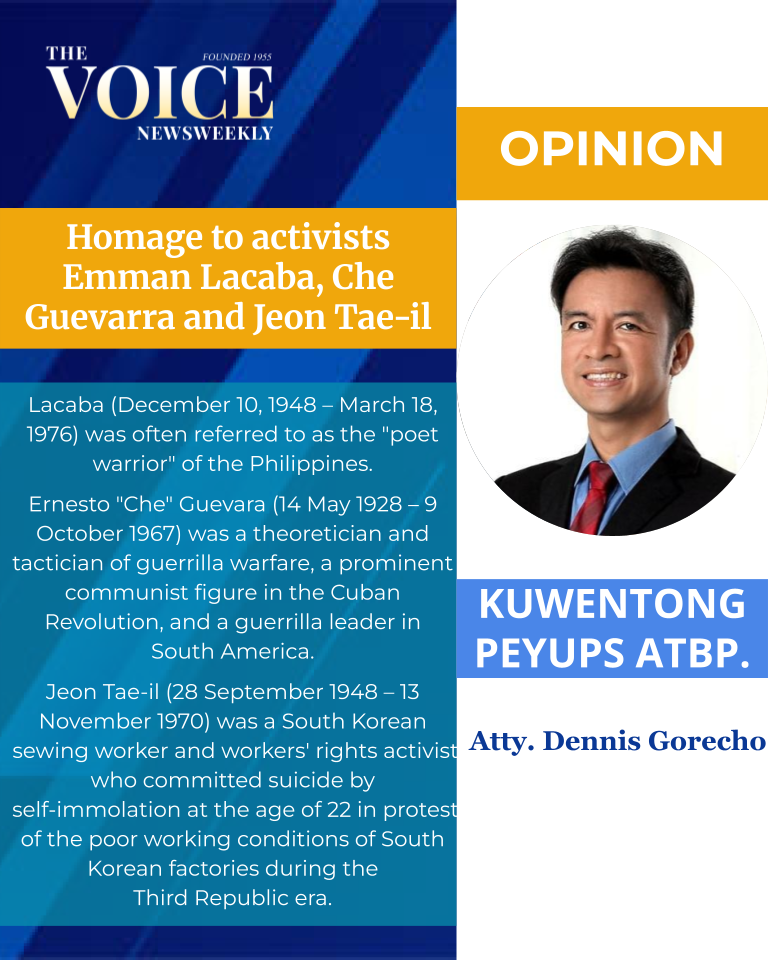
Lacaba (December 10, 1948 – March 18, 1976) was often referred to as the “poet warrior” of the Philippines, with a long list of “job descriptions”: a Filipino activist writer, poet, essayist, playwright, short story writer, scriptwriter, songwriter, magazine illustrator, a stage actor, and a production hand.
He was perhaps the first nationally-known creative writer who joined the armed struggle against the Marcos dictatorship. He famously traded city life to immerse himself in the grassroots labor movement, later joining the armed struggle in Mindanao. After he went deeper into the Philippines’ underground, his poems and stories continued to circulate and find wide readership.
After he was tragically killed by government forces in 1976, posthumous collections of his powerful works, like Salvaged Poems (1986) and Salvaged Prose (1992), cemented his legacy.
Some portions of his “Open Letters To The Filipino Artists” stated: “We are tribeless and all tribes are ours. We are homeless and all homes are ours. We are nameless and all names are ours. To the fascists we are the faceless enemy Who come like thieves in the night, angels of death: The ever moving, shining, secret eye of the storm. The road less traveled by we’ve taken. And that has made all the difference: The barefoot army of the wilderness We all should be in time. Awakened, the masses are Messiah. Here among workers and peasants our lost Generation has found its true, its only home”.
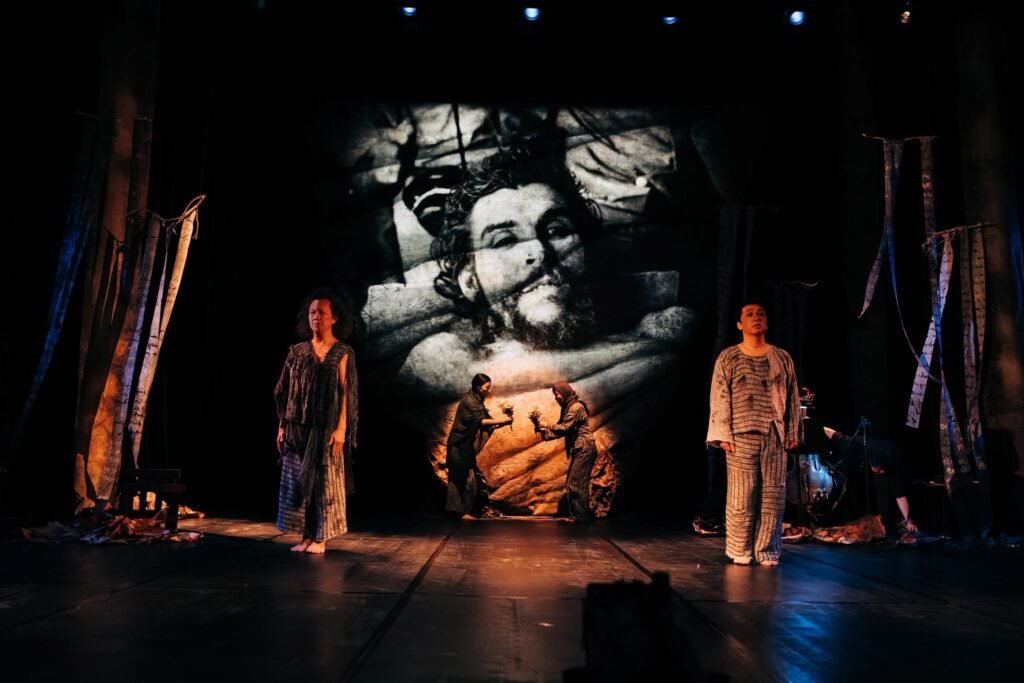
Lacaba’s works were featured in the play “Farewell, Let’s Go to the South” at the Tanghalang Ignacio Gimenez of the Cultural Center of the Philippines (CCP).
It is a powerful cross-Asian theatrical production that explores themes of revolution, sacrifice, and collective memory of three iconic figures: Lacaba, Argentine revolutionary Che Guevara, and South Korean labor activist Jeon Tae-il.
The production was a collaboration between Assignment Theater (Taiwan), Space Theater (Korea), and Tanghalang Pilipino (Philippines). It combined physical theater, poetic language, and live cello music to create a moving meditation on what it means to stand up for justice.
Ernesto “Che” Guevara (14 May 1928 – 9 October 1967) was a theoretician and tactician of guerrilla warfare, a prominent communist figure in the Cuban Revolution (1956–59), and a guerrilla leader in South America.
After his death, his body was laid out on a concrete slab — an image the soldiers who killed him thought would serve as their ultimate government propaganda. Unexpectedly, when the photograph was published, it completely flipped the world’s perspective.
After his execution by the Bolivian army, he was regarded as a martyred hero by generations of leftists worldwide, and his image became an icon of leftist radicalism and anti-imperialism.
Jeon Tae-il (28 September 1948 – 13 November 1970) was a South Korean sewing worker and workers’ rights activist who committed suicide by self-immolation at the age of 22 in protest of the poor working conditions of South Korean factories during the Third Republic era.
His death brought attention to the country’s substandard labor conditions and advanced the formation of a labor union movement in South Korea.
The work traces the final reflections of the three men as they bid farewell to themselves, their families, and the world. Through vivid movement, striking imagery, and the avant-garde sounds of a live cello, the performance unfolds as a meditation on conviction, memory, and the cost of resistance.
Utilizing Asian bodies, poetic language, and an imagistic performance space,” Farewell, Let’s Go South” reclaims the human qualities increasingly diminished by forces of power and control, particularly the enduring spirit of love and sacrifice.
“The South is a symbol of revolution. The South is a symbol of sacrifice and love. While this play depicts the stories of three revolutionary heroes, its deeper aspiration is to bring memory right before our eyes, in summoning the long-lost essence of love and sacrifice in human nature,” said Taiwanese playwright Chung Chiao of Assignment Theater.
In the play, Jeon Tae-il utters the words, “Don’t let my death be in vain,” hoping his mother will carry on the flame of his labor movement. Through a moving physical interaction between mother and son, the scene allows the audience to witness the flight of his soul after burning.
“Remembering them is not an act of nostalgia. It is a question about the kind of world we choose to build today. War has not disappeared. Imperialism returns in different forms. Mass violence and discrimination continue to repeat themselves,” said Korean director Jun Sangbae.
“Farewell, Let’s Go to the South” is part of Tanghalang Pilipino’s 40th anniversary season with a lineup of productions that celebrates its artistic legacy while looking ahead to the future of Philippine theater.
(𝑃𝑒𝑦𝑢𝑝𝑠 𝑖𝑠 𝑡ℎ𝑒 𝑚𝑜𝑛𝑖𝑘𝑒𝑟 𝑜𝑓 𝑡ℎ𝑒 𝑈𝑛𝑖𝑣𝑒𝑟𝑠𝑖𝑡𝑦 𝑜𝑓 𝑡ℎ𝑒 𝑃ℎ𝑖𝑙𝑖𝑝𝑝𝑖𝑛𝑒𝑠. 𝐴𝑡𝑡𝑦. 𝐷𝑒𝑛𝑛𝑖𝑠 𝑅. 𝐺𝑜𝑟𝑒𝑐ℎ𝑜 ℎ𝑒𝑎𝑑𝑠 𝑡ℎ𝑒 𝑆𝑒𝑎𝑓𝑎𝑟𝑒𝑟𝑠’ 𝐷𝑖𝑣𝑖𝑠𝑖𝑜𝑛 𝑜𝑓 𝑡ℎ𝑒 𝑆𝑎𝑝𝑎𝑙𝑜 𝑉𝑒𝑙𝑒𝑧 𝐵𝑢𝑛𝑑𝑎𝑛𝑔 𝐵𝑢𝑙𝑖𝑙𝑎𝑛 𝐿𝑎𝑤 𝑂𝑓𝑓𝑖𝑐𝑒𝑠. 𝐹𝑜𝑟 𝑐𝑜𝑚𝑚𝑒𝑛𝑡𝑠, 𝑒-𝑚𝑎𝑖𝑙 𝑖𝑛𝑓𝑜@𝑠𝑎𝑝𝑎𝑙𝑜𝑣𝑒𝑙𝑒𝑧.𝑐𝑜𝑚, 𝑜𝑟 𝑐𝑎𝑙𝑙 0908-8665786.)