
Amicus Curiae by Atty. Dennis Gorecho
My recent visit in Turkey, a predominantly Muslim country, reminds me of Pope Leo XIV’s message of “logic of littleness”.
The Pope was in Turkiye on November 2025 where Christians (approximately 25,000 to 36,000) comprise only around 0.05% of the total population.
The community is primarily concentrated in Istanbul and is composed of a diverse mix of Latin Rite expatriates/Levantines, Eastern Rite Catholics (Chaldean, Armenian, and Syriac), and a growing number of ethnic Turkish converts.
Turkey is a predominantly Muslim country, with estimates indicating that over 98% of the population identifies as Muslim.
However, the nation is constitutionally a secular republic, meaning there is no official state religion, and the government guarantees freedom of religion and conscience for all citizens.
Turkey has a long history of Christianity, dating back to the early centuries of the religion: Abraham’s journey through Harran, the early Christian communities in Antioch and Ephesus, and the long and influential history of Byzantine Christianity.
It is also the region where Saint Paul was born, where Saint John and the Virgin Mary lived (House of the Virgin Mary near Ephesus), and where the first seven ecumenical councils were held.
Pope Leo XIV encouraged Turkey’s small Catholic community to rediscover what he called the Gospel’s “logic of littleness,” urging them not to be discouraged by their tiny numbers but to recognize in them the strength of authentic Christian witness.
He emphasized that the Church’s true strength lies not in numbers, wealth, or political power, but in quiet witness, humility, and authentic service to the vulnerable.
“When we look with God’s eyes, we discover that he has chosen the way of littleness,” he said, adding that the Church’s true strength “does not lie in her resources or structures nor in numbers or influence, but in remaining gathered around Christ and sent by the Holy Spirit.”
Pope Leo is not the first pontiff to visit Istanbul. Four of his predecessors have also made the journey: Paul VI in 1967, John Paul II in 1979, Benedict XVI in 2006, and Francis in 2014; while Archbishop Angelo Roncalli—who later became Pope John XXIII—served in Istanbul as Apostolic Delegate to Türkiye and Greece from 1935 to 1944.
I prayed inside the Church of St. Anthony of Padua located on Istanbul’s Istiklal Avenue where Pope St. John XXIII preached and served from 1935 to 1944. It is the largest Roman Catholic church in the city.
It was one of three Levantine parishes in Beyoğlu together with the churches of St. Mary Draperis (also on İstiklal Avenue), and of SS. Peter and Paul in Galata.
Focusing heavily on pastoral outreach to refugees and vulnerable populations, there are around 50 parishes and mission stations operating across the country, served by roughly 100 priests and a network of religious sisters who also run schools, hospitals, and care homes.
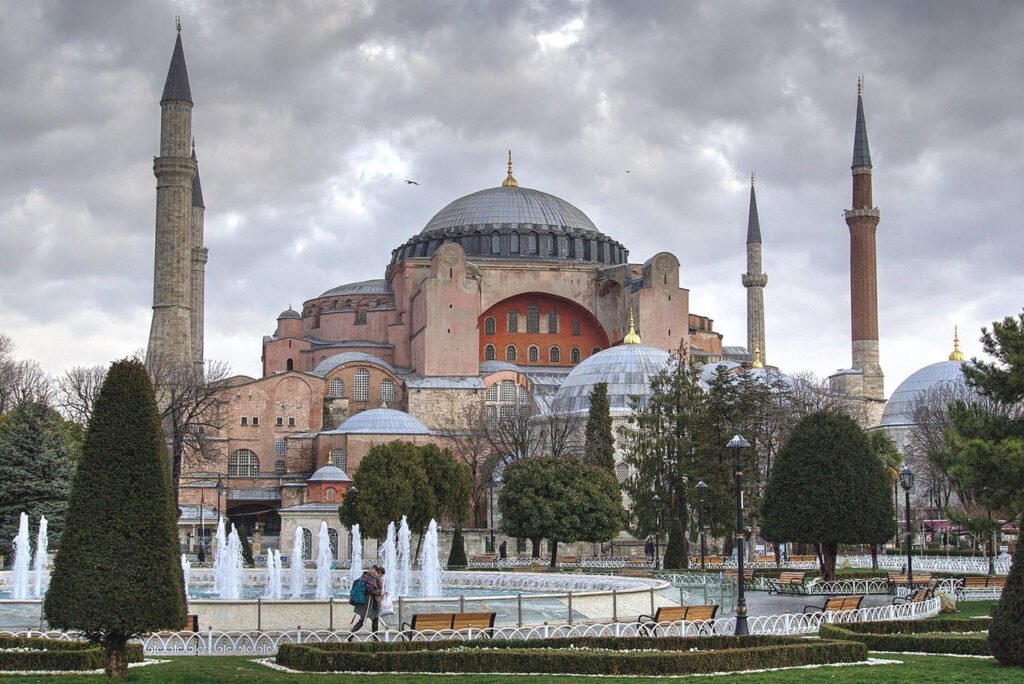
I also visited the interesting structure of Hagia Sophia, formally called the Temple of God’s Holy Wisdom, which is a monumental architectural and historical landmark located in Istanbul.
Originally built as a Byzantine Christian cathedral in AD 537, it was later converted to an imperial mosque in 1453, served as a museum from 1935, and was reclassified as a mosque in 2020.
As Byzantine Cathedral (537–1453), this third iteration of the church stood as the largest cathedral in Christendom for nearly a thousand years. It heavily influenced Eastern Orthodox and later Ottoman architectural styles.
The breathtaking Byzantine mosaics of the Hagia Sophia are masterpieces of Christian art, with images of Jesus Christ, Virgin Mary, John the Baptist, among others, constructed from millions of colored glass and gold tiles.
When the building became an Ottoman mosque in 1453, many of these masterpieces were covered over with plaster or whitewash rather than destroyed, which remarkably preserved them for centuries.
The Department of Foreign Affairs in Turkey reported that there are over 3,000 Filipinos who are based in Turkey composed of service workers, students, and a number of professionals and Filipinos married to Turkish nationals.
Diplomatic relations between the Philippines and Türkiye were established with the Treaty of Friendship signed on 13 June 1949.
The DFA website said that “The bilateral ties have seen a significant growth in a wide range of areas, most notably in the fields of defense, trade and investment, development cooperation, and people-to-people linkages in tourism, culture, and education. “
Bilateral trade between the Philippines and Turkiye stood at $365 million in 2025.
The Philippine exports to Türkiye include tropical fruits, coconut products, electrical machinery, textiles, and charcoal. Turkish exports to the Philippines include defense equipment (such as helicopters), pharmaceuticals, tobacco, poultry, and chemicals.
Jaime Ramon Ascalon Jr., is the current Ambassador of the Philippines in Turkiye.
(𝐴𝑡𝑡𝑦. 𝐷𝑒𝑛𝑛𝑖𝑠 𝑅. 𝐺𝑜𝑟𝑒𝑐ℎ𝑜 𝑖𝑠 𝑡ℎ𝑒 𝑗𝑢𝑛𝑖𝑜𝑟 𝑝𝑎𝑟𝑡𝑛𝑒𝑟 𝑤ℎ𝑜 ℎ𝑒𝑎𝑑𝑠 𝑡ℎ𝑒 𝑆𝑒𝑎𝑓𝑎𝑟𝑒𝑟𝑠’ 𝐷𝑖𝑣𝑖𝑠𝑖𝑜𝑛 𝑜𝑓 𝑡ℎ𝑒 𝑆𝑎𝑝𝑎𝑙𝑜 𝑉𝑒𝑙𝑒𝑧 𝐵𝑢𝑛𝑑𝑎𝑛𝑔 𝐵𝑢𝑙𝑖𝑙𝑎𝑛 𝐿𝑎𝑤 𝑂𝑓𝑓𝑖𝑐𝑒𝑠. 𝐹𝑜𝑟 𝑐𝑜𝑚𝑚𝑒𝑛𝑡𝑠, 𝑒-𝑚𝑎𝑖𝑙 𝑖𝑛𝑓𝑜@𝑠𝑎𝑝𝑎𝑙𝑜𝑣𝑒𝑙𝑒𝑧.𝑐𝑜𝑚, 𝑜𝑟 𝑐𝑎𝑙𝑙 0908-8665786.)