Kuwentong Peyups Atbp. by Atty. Dennis Gorecho
“Linog! Linog!”
Words I heard while talking over the phone with Father Victor Bompat of Stella Maris in Tagbilaran, Bohol at 8:12 AM of October 15, 2013.
A few minutes later social media was flooded with news that a 7.2-magnitude earthquake struck Bohol and nearby provinces.
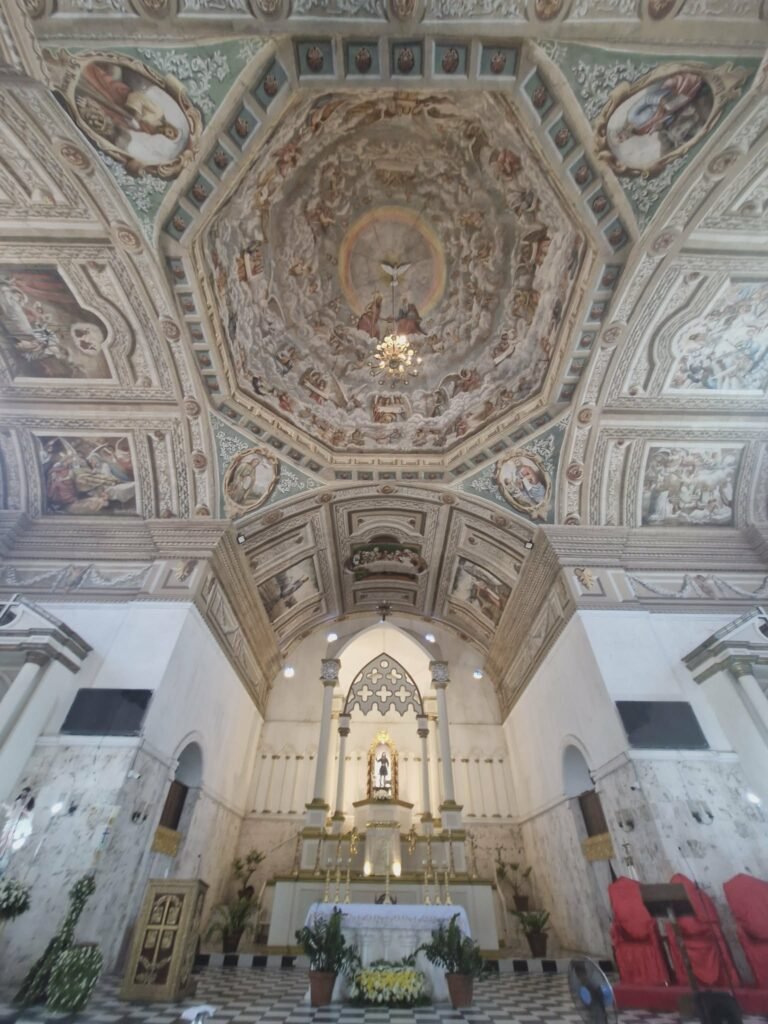
It turned out that our short conversation saved Fr. Bompat from falling rocks as he was supposed to celebrate a mass at that time inside Dauis church during the earthquake, wherein fallen rocks damaged the altar area.
With its epicenter located near the boundary of Sagbayan and Catigbian towns, the tremor lasted for about 30 seconds that was one of the strongest to hit the country in recent history, toppling centuries-old churches, splitting roads apart, and leaving widespread destruction in its wake.
The earthquake caused heavy damages to 25 churches in the Diocese of Tagbilaran and 9 churches in the Diocese of Talibon.
The damaged churches in the Diocese of Tagbilaran included those in Alburquerque, Antequera, Baclayon, Balilihan, Batuan, Calape, Catigbian, Corella, Cortes, Dimiao, Dauis, Garcia-Hernandez, Lila, Loay, Loboc, Loon, Maribojoc, Panglao, Sagbayan, Sevilla, Sikatuna, Tagbilaran, and Valencia.
The damaged churches in the Diocese of Talibon included those in Carmen, Clarin, Inabanga, Talibon, Tubigon.
Among the notable damaged parts of the churches are the painted ceilings displaying biblical scenes and celestial imagery.
Many feature trompe-l’œil works by Cebuano artists Raymundo Francia (dubbed “Cebu’s Michelangelo”) and Canuto Avila.
Francia is the genius behind the enchanting murals of Alburquerque, Anda, Balilihan, Carmen, Cortes, Dauis, Dimiao, Inabanga, Jagna, Lila, Loay, Loboc, Loon, Maribojoc, Panglao, Sevilla, Tubigon and Valencia.
It was Monsignor Juan Gorordo, first Filipino bishop of Cebu (1910-1932) who discovered the talent of Francia and recommended him to his friend and parish priest of Dauis, Bohol, Father Natalio del Mar.
The church of Dauis was consecrated in 1923, the first of Francia’s Boholano masterpieces.
From there, the tradition of painting church ceilings in Bohol spread like wildfire.
Like Michaelangelo, Francia usually worked by lying on his back on a scaffold constructed several meters above the floor.
Despite the lack of modern mechanical instruments, he managed to embellish church ceilings with his paintings with the precision and meticulous craftsmanship that was uniquely his own. His technique is primarily trompe l’oeil, designed to create optical illusions of three-dimensional space and grandeur.
A ceiling is more than a simple, functional engineering solution. The word ceiling traces its roots from the Latin word caelum, which means heaven or sky, thus “vision of”.
These ceiling paintings are not just for show as the murals served as “visual bibles” to educate the populace.
Artists were commissioned by the church to paint the walls and ceilings to visually catechize the Filipinos through telling the stories of the new and old testament. Many of the murals portray scenes from the life of Christ, his mother and various saints.
Beyond its religious symbolism, the murals serve as enduring visual narratives to how sacred stories are woven into the very fabric of Boholano identity through church architecture and decorative arts.
Anachronistic elements became increasingly common in some paintings, incorporating scenes and figures of remote town life into Gospel scenes and lives of the Saints in medieval times.
Art in a sacred space is used to represent and re-create the divine realities, signifying a fusion of divinity and humanity.
The initial response of a person as one goes inside past the church portals could vary from a feeling of intimacy with God, to an overwhelming sense of awe.
An elemental factor to the person’s foremost impact from his viewpoint is the height of the ceiling from the ground. The higher the ceiling, the more heightened the evoking emotion of “Visions of Heaven on Earth” experience.
During my recent visit in my family’s hometown of Tubigon, I was again mesmerized by Francia’s ceiling art in San Isidro Labrador Parish Church that features the “Queen of Bohol Domes,” a majestic di sotto in su (foreshortened) painting of Mary’s coronation. Other murals include the Seven Sacraments and the Triumphant Entry of Jesus into Jerusalem.
Boholano Artist Marc John Frontreras is one of those involved in the rehabilitation and conservation efforts in the ceiling artworks heavily damaged during the 2013 earthquake or by Typhoon Odette,
Frontreras noted that restoring and conserving church ceiling art involves complex, high-stakes challenges that balance structural, artistic, and environmental factors to preserve sacred history.
He stressed that common challenges include water damage, structural instability, and the reversal of past, improper restorations.
(𝑃𝑒𝑦𝑢𝑝𝑠 𝑖𝑠 𝑡ℎ𝑒 𝑚𝑜𝑛𝑖𝑘𝑒𝑟 𝑜𝑓 𝑡ℎ𝑒 𝑈𝑛𝑖𝑣𝑒𝑟𝑠𝑖𝑡𝑦 𝑜𝑓 𝑡ℎ𝑒 𝑃ℎ𝑖𝑙𝑖𝑝𝑝𝑖𝑛𝑒𝑠. 𝐴𝑡𝑡𝑦. 𝐷𝑒𝑛𝑛𝑖𝑠 𝑅. 𝐺𝑜𝑟𝑒𝑐ℎ𝑜 ℎ𝑒𝑎𝑑𝑠 𝑡ℎ𝑒 𝑆𝑒𝑎𝑓𝑎𝑟𝑒𝑟𝑠’ 𝐷𝑖𝑣𝑖𝑠𝑖𝑜𝑛 𝑜𝑓 𝑡ℎ𝑒 𝑆𝑎𝑝𝑎𝑙𝑜 𝑉𝑒𝑙𝑒𝑧 𝐵𝑢𝑛𝑑𝑎𝑛𝑔 𝐵𝑢𝑙𝑖𝑙𝑎𝑛 𝐿𝑎𝑤 𝑂𝑓𝑓𝑖𝑐𝑒𝑠. 𝐹𝑜𝑟 𝑐𝑜𝑚𝑚𝑒𝑛𝑡𝑠, 𝑒-𝑚𝑎𝑖𝑙 𝑖𝑛𝑓𝑜@𝑠𝑎𝑝𝑎𝑙𝑜𝑣𝑒𝑙𝑒𝑧.𝑐𝑜𝑚, 𝑜𝑟 𝑐𝑎𝑙𝑙 0908-8665786.)