
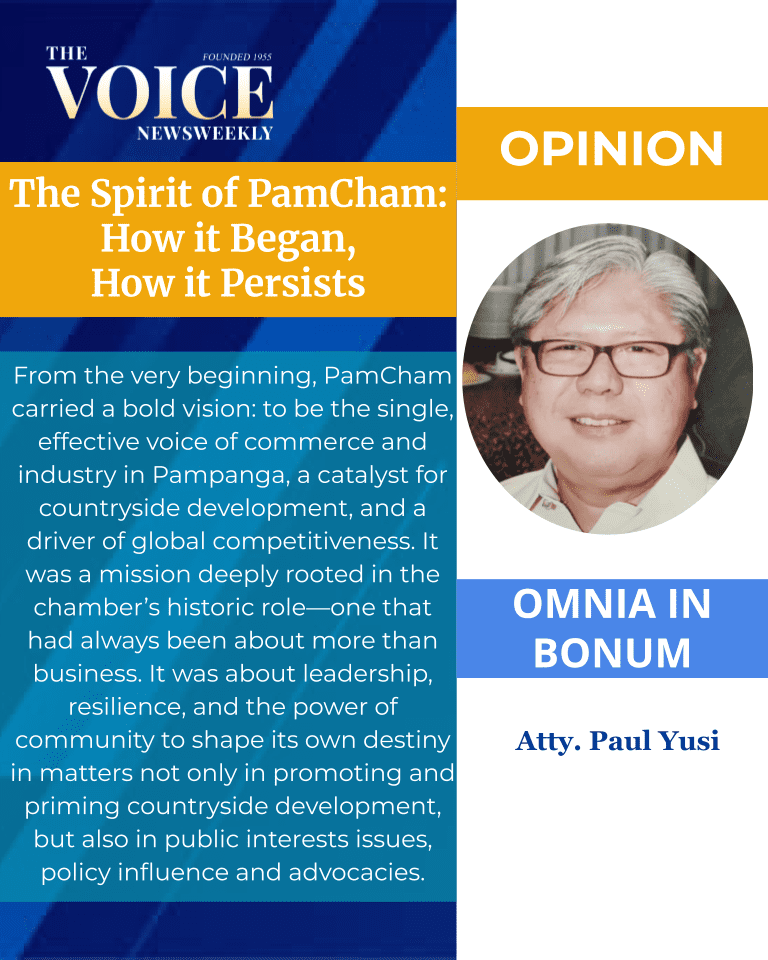
Omnia in Bonum by Atty. Paul Yusi
As we approach the 25th legal founding and silver anniversary of the Pampanga Chamber of Commerce and Industry, Inc. (PamCham) on October 3, 2028, this piece seeks to revisit what has been forged and already written in the past, yet remains relevant today.
In October 1988, the then San Fernando Chamber of Commerce and Industry (SFCCI) was born—a fledgling organization that would eventually grow into PamCham as we know it today.
At the helm was prime mover and founder Liberato “Levy” P. Laus and a handful of pioneering officers. Their inaugural induction ceremony took place in the newly opened Tire City in the neighborhood of Dolores, San Fernando.
In its infancy, the SFCCI tackled the everyday concerns of local traders—from navigating taxes to understanding government policies, all the way to maintaining peace and order. But as time went on, a bigger dream began to unfold—a vision of transforming the once-sleepy capital town of San Fernando into a vibrant business center at the heart of Central Luzon.
Before long, this dream found a focal point in “Dolores City,” a burgeoning growth enclave that soon had everyone talking. The chamber’s first notable initiative was the lighting of the MacArthur Highway and the Gapan–San Fernando–Olongapo Road in Dolores. It was more than just a lighting project—it was an invitation to the community. It encouraged residents to become aware, to step into the light—literally and figuratively—and to take an active role in the transformation of their hometown.
The deep grounding of SFCCI in the development of San Fernando led to a change in the organization’s identity into something as endearing as its new name conveyed: the Lugud San Fernando Movement. Eventually, this grounding would be tested by the biggest and most daunting challenge ever to face the capital town since its founding nearly 250 years ago. The cataclysmic eruption of Mt. Pinatubo in 1991 inevitably pushed Lugud into a more critical role—not only in promoting business in the capital town but also in protecting it from the adversities brought about by the massive calamity.
At first, the group focused on the forefront of inviting businessmen, allaying fears that lahar would pose a real problem to the community. At the same time, it kept a close watch on the lahar situation in close coordination with concerned agencies, particularly the Philippine Institute of Volcanology and Seismology (PHIVOLCS). When the lahar problem became a real threat to the community, Lugud leaders felt that promoting business development was already a losing proposition. The community had to be saved from lahar devastation first before anything else.
In the face of this daunting challenge, Lugud transformed into a new organization—the Save San Fernando Foundation, Inc. Save spearheaded a multi-sectoral campaign to protect the town and nearby municipalities from lahar destruction. It managed to raise ₱20 million from various sectors to fund emergency activities and projects, including engineering interventions against deadly lahar flows. Eventually, its relentless advocacy helped pave the way for the construction of the multi-billion 54-kilometer FVR Megadike that finally stopped lahar flows from engulfing the capital town and downstream communities.
The SFCCI had always been deeply rooted in the life of the capital town. Over time, this grounding reshaped the organization’s identity into something warmer and more human, reflected in its new name: the Lugud San Fernando Movement-“lugud” meaning love or compassion.
But destiny had a far greater test in store. In 1991, the cataclysmic eruption of Mt. Pinatubo shook Central Luzon to its core, unleashing devastation unseen in centuries. For San Fernando, then nearly 250 years old, it was the most daunting challenge in its history.
At first, Lugud sought to steady nerves, reassuring businessmen that lahar—the deadly volcanic mudflow—would not cripple the community. Its leaders worked hand in hand with agencies like PHIVOLCS, monitoring the threat and keeping the public informed. Yet as lahar descended and the danger became undeniable, the group realized that business development could no longer be its foremost mission. Before commerce could thrive, the town itself had to be saved.
Thus, Lugud transformed into the Save San Fernando Foundation, Inc. (The Foundation) This was no mere rebranding—it was a rallying cry. Save spearheaded a multi-sectoral campaign, uniting citizens, businesses, and institutions in a common cause: to shield San Fernando and its neighboring towns from devastation. Through sheer determination, the foundation raised ₱20 million, funding emergency engineering works and community-driven defenses against lahar’s advance.
The movement’s relentless advocacy bore fruit. Its voice helped push forward the construction of the monumental 54-kilometer FVR Megadike, a multi-billion peso project that finally stemmed the lahar flows and safeguarded San Fernando and downstream communities.
What began as a chamber of commerce had, through love, courage, and necessity, evolved into a guardian of the town’s very survival. The story of Lugud and Save San Fernando is not just about business—it is about resilience, unity, and the unyielding will of a community to endure.
By 2002, the shadow of lahar that once threatened San Fernando had finally lifted. With the danger now behind them, the community faced a new challenge: how to return the Foundation to its original role as a chamber of commerce. The time had come to reorganize, to breathe life back into the vision of a united business community.
In late August of that year, Mr. Laus took the decisive step. Together with a circle of respected traders and professionals—some of whom are still actively engaged with PamCham and have endured through the years—Jesus Nicdao, Teresa D. Carlos, Ruben A. Sy, and others—they formed the nucleus of what would soon officially become the Pampanga Chamber of Commerce and Industry, Inc. or PamCham.
Momentum built quickly. On September 9, the first organizational meeting was held. Just two weeks later, members gathered at the Laus Group Corporate Center for a series of orientations. By October 3, the chamber—then called PACCI—was officially registered with the Securities and Exchange Commission (SEC) on October 3, 2003. Within days, PamCham’s officers were already representing Pampanga at the regional area conference of the Philippine Chamber of Commerce and Industry (PCCI) in Dagupan City.
On October 16, PamCham’s membership was formally approved by the PCCI, cementing its place in the national network of business chambers.
From the very beginning, PamCham carried a bold vision: to be the single, effective voice of commerce and industry in Pampanga, a catalyst for countryside development, and a driver of global competitiveness. It was a mission deeply rooted in the chamber’s historic role—one that had always been about more than business. It was about leadership, resilience, and the power of community to shape its own destiny in matters not only in promoting and priming countryside development, but also in public interests issues, policy influence and advocacies.
Today, PamCham continues to breed and train its next core of volunteer leaders as it endures to be the voice of commerce and industry in the Province towards its 25th Silver Founding Anniversary by year 2028 and beyond.
(Source: Lifted from History of PamCham; December 2003 Souvenir Program; Charter Presentation and Induction Ceremonies)